

A customer is on hold for 17 minutes with a question about her insurance policy. Your agent scrolls through a 50-page document, then messages a colleague on Slack, hoping they know the answer. The call ends with the customer frustrated, ready to switch to a competing vendor, or worse, a wrong answer that triggers a compliance investigation.
Most advice on how to improve call center customer service focuses on the agent’s behavior, like their tone or speed. None of it explains what just happened: your agent couldn’t access the right information fast enough while attending to a customer.
If you can fix that, call handle time and overall customer satisfaction will follow.
Here are eight strategies to achieve this:
- Centralize Knowledge Into a Single Source of Truth
- Give Agents Answers, Not Documents
- Guide Complex Calls With Step-by-Step Decision Support
- Shorten Onboarding With Knowledge, Not Longer Training
- Use Call Data to Find and Fix Recurring Knowledge Gaps
- Deflect Routine Calls With Self-Service That Uses Approved Answers
- Deploy AI With Governance Behind It
- Track the Metrics That Reflect Service Quality.
Why Most Call Center Service Problems Are Knowledge Problems
At most contact centers, knowledge is scattered across CRMs, Slack threads, lengthy policy documents, and what individual employees can recall. This is information your agents need during live calls, yet it’s rarely in one place.
When a company’s data is fragmented like this, agents waste time searching for answers rather than attending to customers. That’s what drives long average handle time (AHT) and low first call resolution (FCR). It also means two agents can give different answers to the same question, which turns into a compliance problem the moment a regulator asks why.
Call agents on Reddit have shared similar experiences. During live interactions, they frantically switch between apps, reach out to team members, or piece together answers from lengthy articles. To save time, they guess, but find out later the answer was wrong.
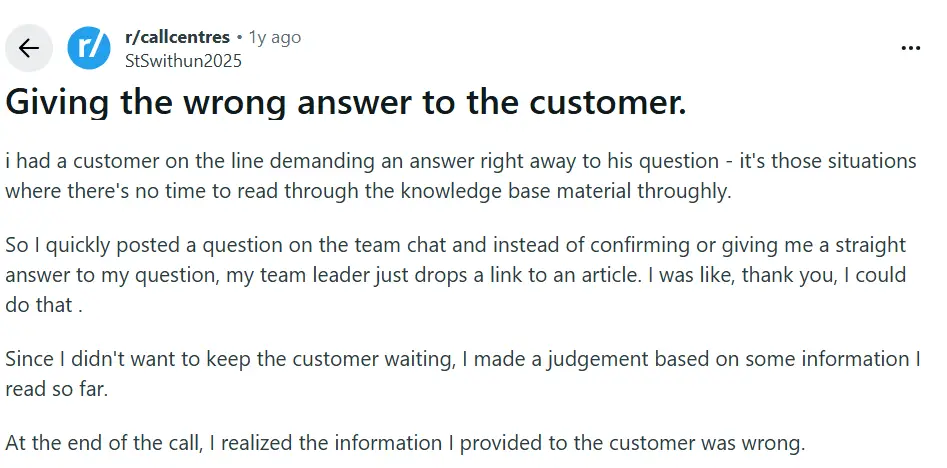
Unlike what many contact managers assume, the problem here has nothing to do with your agents’ empathy for customers or speed in resolving complaints. They just can’t find the information they need in time.
Once agents find answers fast, handle time and resolution rates take care of themselves.
ME Bank’s agents used to search through multiple wikis to answer a single call. After switching to livepro’s centralized knowledge base, 39% of staff agreed that information was easier to find, and average handling time dropped by 40%.
How to Improve Call Center Customer Service: 8 Proven Ways
Here are eight ways to improve customer service in your call center:
1. Centralize Knowledge Into a Single Source of Truth
When 50+ agents juggle multiple knowledge systems, they might end up giving customers conflicting answers. If a customer asks about a specific insurance coverage, one agent might check the wiki while another relies on an outdated email.
The solution isn’t to teach agents where to look, but to organize your company’s data into a single knowledge base. During calls, agents search the same source and find the same up-to-date answers.
Salesforce’s State of Service research found that 58% of agents at underperforming organizations toggle between multiple screens to find what they need. A centralized knowledge base eliminates that friction. Agents deliver consistent answers, and customers are more likely to get the right information on the first call. Compliance risk also falls because everyone works from the same up-to-date information.
2. Give Agents Answers, Not Documents
Even with a single knowledge base, calls can still be delayed if searches return documents instead of direct answers. Customers are left waiting on hold while agents dig through lengthy PDFs for the information they need. This increases AHT and lowers customer satisfaction (CSAT).
Your agents need a knowledge base that provides clear answers. When an agent asks if a rider is covered by the insurance policy, they see “Yes, it’s covered up to $10,000,” instead of a document they have to read. This helps them resolve calls faster.
3. Guide Complex Calls With Step-By-Step Decision Support
Not every customer question has a simple answer. Complex calls often require agents to evaluate multiple pieces of information before responding. If a financial services agent is asked about a hardship plan, they need to check account standing and prior plan usage before answering. When that process isn’t clearly documented, two agents can reach different conclusions from the same knowledge base.
Step-by-step decision support, often called a decision tree, guides agents through each condition until they reach the right outcome.
Here’s what that looks like in practice:
- Agent selects “hardship payment plan inquiry” as the call type.
- The tree asks whether the account is in arrears. Agent clicks yes.
- The tree asks how long the account has been in arrears. Agent enters 45 days.
- The tree asks whether the customer has used a hardship plan before. Agent clicks no.
- Based on those answers, the tree returns one outcome: the customer qualifies for a hardship plan at reduced payments.
Every agent reaches the same answer, and if a regulator asks how, you have a documented process to prove it.
Atlanticus saw this directly. After guiding agents through complex calls with decision trees, the financial services company cut average handle time by 14%. They also reached 100% compliance as agents stopped relying on unofficial workarounds.
4. Shorten Onboarding With Knowledge, Not Longer Training
New agents typically need 6 to 8 months to perform at the level of experienced staff. Most onboarding tries to close that gap by having them memorize policies and procedures that go stale the moment there’s an update.
One agent described this on Reddit. Three weeks into training, their resources were spread across four places. It was hard to navigate, and they were told not to ask their mentor until they’d exhausted everything else themselves. They took live calls not knowing where to search, while customers waited.
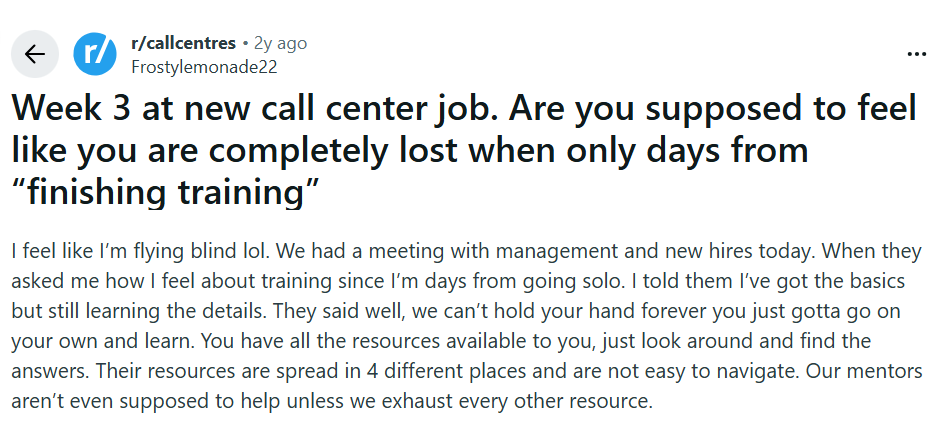
Give this agent a single knowledge base they can search, and the months of memorizing disappear.
Liverpool City Council saw exactly this shift. Once agents searched a knowledge base instead of memorizing data they’d soon forget, onboarding dropped from 26 weeks to 4.
5. Use Call Data to Find and Fix Recurring Knowledge Gaps
A knowledge gap usually stays invisible until it’s already caused damage. When agents can’t find a clear answer, they keep customers on hold, then guess and move on to the next call. Each agent guesses differently, and inconsistent or wrong answers build up before anyone traces them back to the missing knowledge that started it.
Fixing that means reviewing call data and search analytics to catch gaps before they lead to wrong answers or a compliance risk:
- Call Recordings: Review how agents searched for information and where they struggled.
- Repeat Call Rate: Spot topics that cause customers to call back because they didn’t get the right answer.
- Zero-result Searches: Show questions the knowledge base can’t answer.
- No-click Searches: Suggest agents didn’t find a useful result.
A QA analyst using this data can trace a wrong answer to its source and fix it before it spreads.
6. Deflect Routine Calls With Self-Service That Uses Approved Answers
Routine customer requests like password resets and balance checks don’t need a human agent’s attention. When these pile up, they keep agents too occupied to handle the calls that actually need a person.
Self-service portals fix this by helping customers find answers without raising a ticket. 70% of businesses have already implemented one, and for good reason. These portals pull from the same knowledge base agents use, so they stay current as that knowledge base updates. Repetitive calls get deflected, freeing agents to handle the cases that need them.
7. Deploy AI With Governance Behind It
Most advice on improving call center service slaps AI on as an easy fix. They tell you to offer an AI chatbot or voice agent for round-the-clock support and customer satisfaction will go up. 52% of AI-powered chatbot users say it makes solving problems faster and easier, so on paper, this works. What none of that advice mentions is the risk of deploying AI without a governed knowledge base that monitors content accuracy and compliance.
Air Canada found this out the hard way. Its AI customer support chatbot gave a customer inaccurate bereavement fare policy information, and a Canadian tribunal ruled the airline responsible for it. AI hallucinates, and unlike a single agent’s mistake, it can deliver the same wrong answer to thousands of customers before anyone catches it.
The fix is connecting AI to a governed knowledge base so it only pulls answers from approved, current data. This keeps compliance risk in check.
8. Track the Metrics That Reflect Service Quality
None of the previous seven strategies means anything if you’re not tracking what they were supposed to achieve for your business. You could implement a centralized knowledge base, decision trees, and governed AI, but you can’t know if your efforts succeeded without measuring the right metrics.
Here are four numbers to measure:
- FCR (First Call Resolution): Do agents resolve customer issues on the first call now, or do customers still have to call back? The industry average is 70%, and world-class call centers hit 80% or higher. But only 5% of centers reach that level.
- AHT (Average Handle Time): How long does each call take? Are agents still struggling to find answers, or are queries resolved quickly?
- CSAT (Customer Satisfaction Score): Has satisfaction improved? World-class CSAT is 85% or higher, a bar only 5% of call centers clear.
- Onboarding Time: How long does it take a new agent to reach full efficiency?
Measure these before and after implementing changes through your knowledge base’s analytics dashboard. This way, you’ll know what’s working and can defend your investment with data. You can also catch gaps early instead of leaving them unattended for weeks or months.
livepro: A Knowledge Management Software to Help You Improve Call Center Customer Service
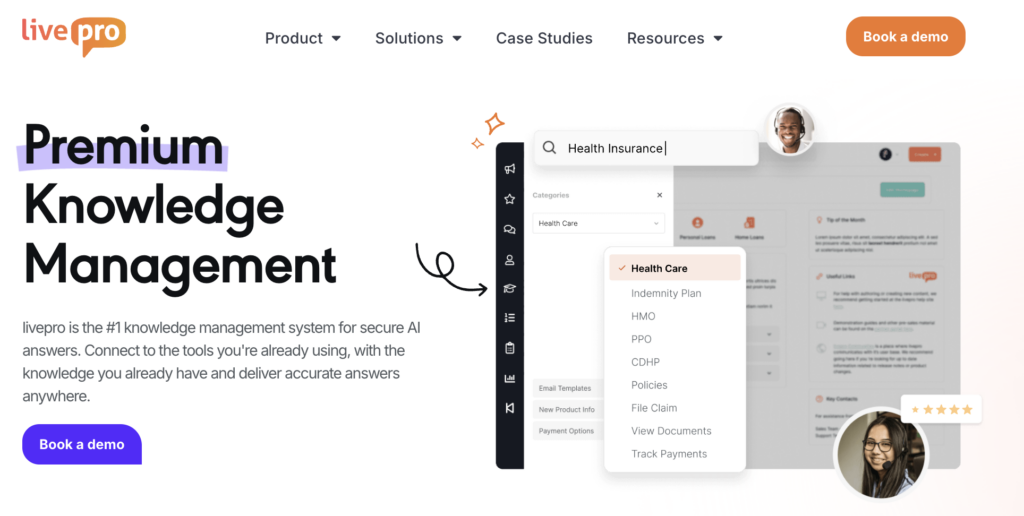
If you want to know how to improve call center customer service in practice, give your agents a single reliable source of answers. That’s what livepro is built for.
It’s an AI-powered knowledge management software for contact centers and enterprises. In G2’s 2026 Spring report, it ranked number one across several core contact center categories, including AI search, analytics, integrations, and compliance governance.
It offers agents one unified knowledge base they can search mid-call.
livepro also offers decision trees for complex queries, self-service portals, and Lune, an AI voice agent for 24/7 support. And with governance controls, every answer a customer gets, whether from an agent, voice assistant, or self-service, is accurate and compliant.
Here’s a closer look at how it works:
Hybrid Lightspeed Search for Faster First-Call Resolution
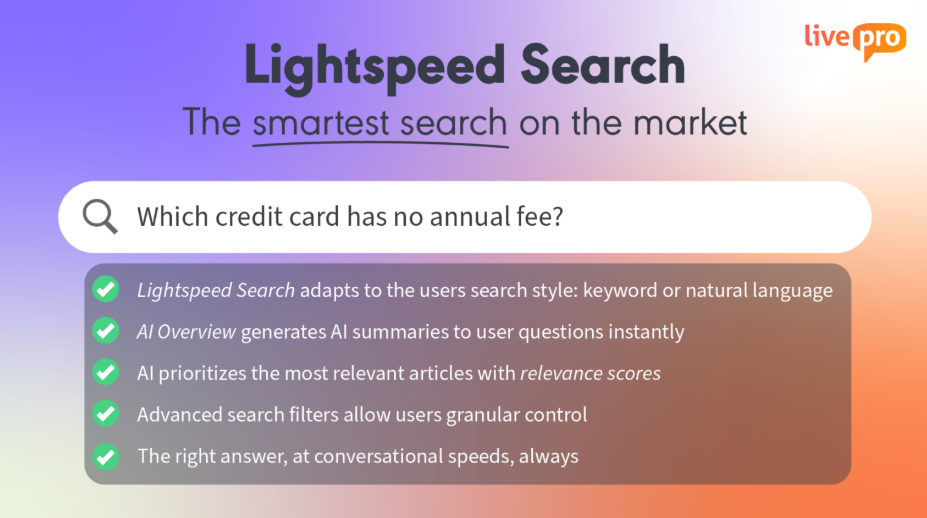
Call agents waste more time searching for answers across knowledge portals, Slack threads, emails, and documentation than actually helping customers. livepro’s Hybrid Lightspeed Search solves this problem. With AI-powered search, agents can find the correct answers fast enough to use during a customer call.
The search uses natural language processing and vector search to interpret the intent behind each request. So even if your agents make typos, or use unfamiliar phrasing, the AI still understands the question and retrieves the right answer in seconds.
Before Atlanticus adopted livepro, agents used official documentation less than 5% of the time because their old system was too slow to search. livepro’s search helped fix that, cutting average handle time by 14%.
Decision Trees for Consistent, Compliant Call Handling
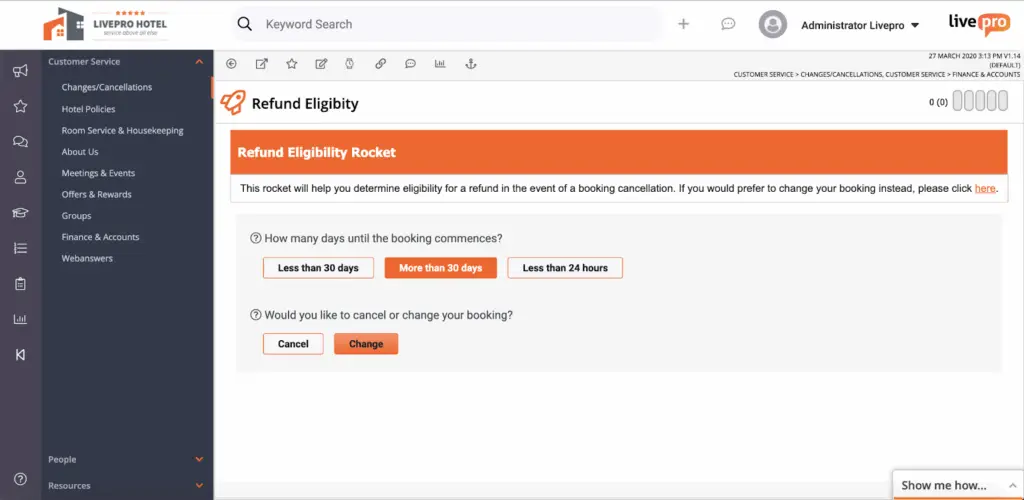
Complex queries, like disputes and escalations, traditionally require agents to memorize lengthy procedures for different situations. With this setup, conflicting or wrong answers become inevitable.
livepro’s decision trees, called Rockets, guide agents through these procedures step by step. Your agents no longer have to rely on memory or dig through 12-page documentation mid-call. They just answer a few questions and Rocket surfaces the right steps based on the customer’s specific situation.
This keeps every answer accurate and compliant, no matter how complicated the query.
Luna AI Voice Agent for 24/7 Customer Support

There’s only so much your human agents can handle. During peak seasons, like holiday sales or after a product recall, customer queries pile up faster than agents can answer them. Callback times increase, and customers stuck on hold get frustrated, dragging down satisfaction scores.
livepro’s Luna offers 24/7 support in multiple languages during these overflow periods. It handles repeat requests, freeing up agents for more complex queries. When a call needs a human, Luna routes it to an agent with the full context already attached, so the agent doesn’t start from scratch. It also covers after-hours calls, when agents are unavailable.
Governance and Version Control for Answers Agents Can Trust
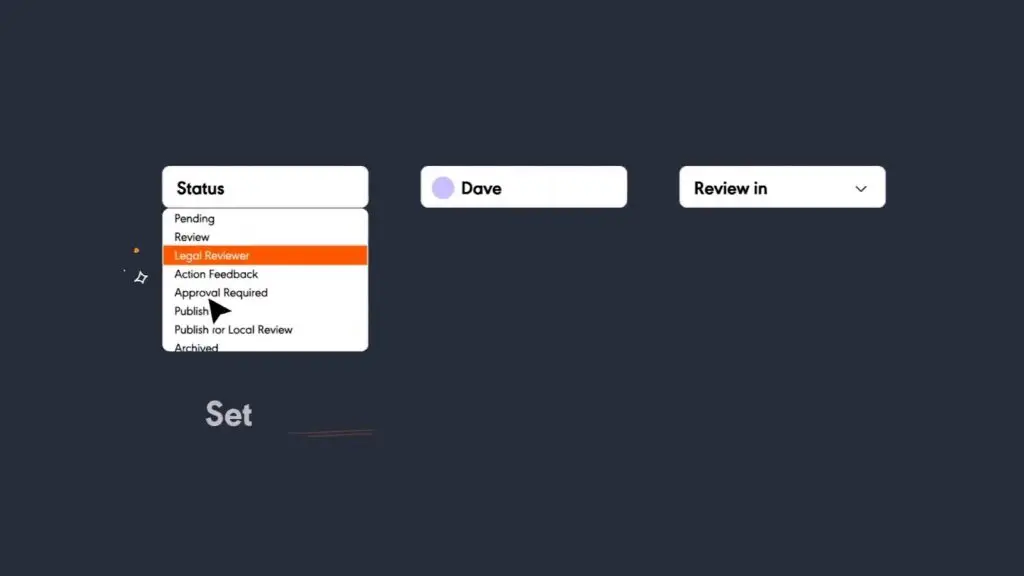
If you work in a regulated industry like healthcare or finance, your organization is only one wrong answer away from a compliance investigation. livepro’s governance framework helps contact centers keep their knowledge base accurate and current.
Every knowledge article follows a workflow for creating content, with strict role-based access that controls who owns, reviews, or edits it. Each article also carries a review and expiry date, and livepro routes it to its owner when review is due. Once a deadline passes, the software hides the expired article from call agents, so no one accidentally gives customers outdated information.
livepro also offers document version control, letting users see who changed an article and what changed. Owners can compare versions and restore an earlier one at any time.
Analytics Dashboards for Spotting Knowledge Gaps Early
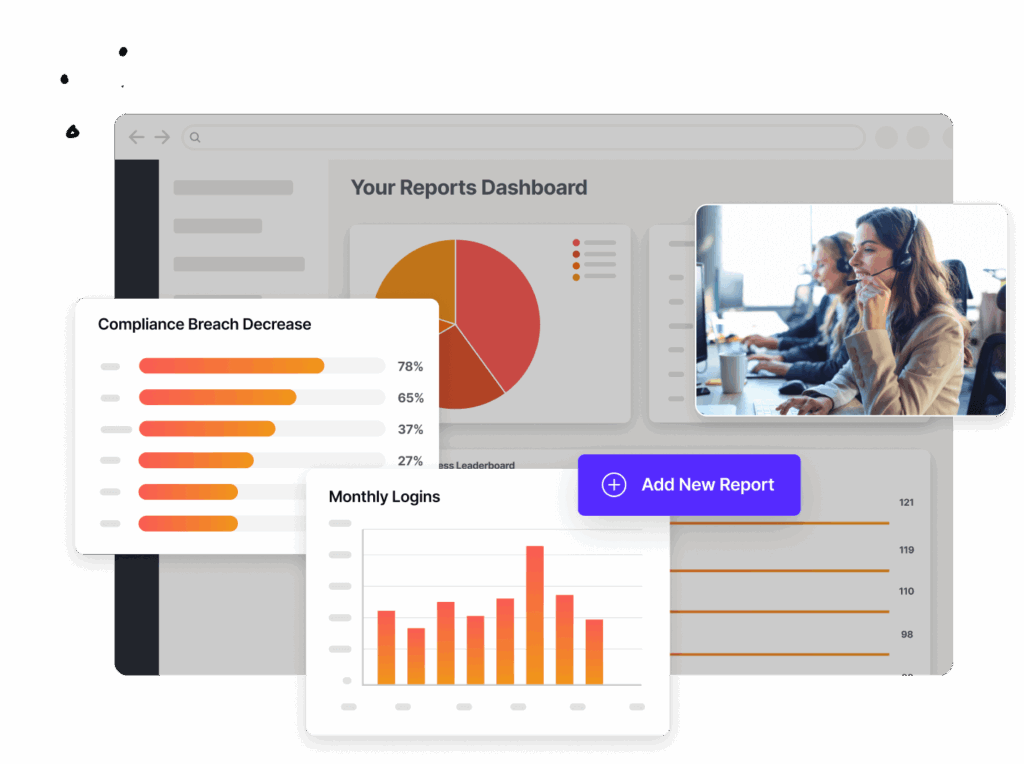
A knowledge base can look complete and still be failing silently. Without visibility into usage, call centers can’t tell which searches come up empty or which departments have quietly stopped using the system. They also can’t tell which articles technically exist but don’t solve anything.
livepro’s knowledge analytics tracks this in real time, with dashboards teams can configure by department or role:
- Trending Searches: Surfaces your most-viewed articles, so you know exactly where accuracy matters most.
- Failed Searches: Catches what people looked for and never found, so you can fix the gap before a customer runs into it.
- Usage Tracking: Flags which teams or agents have stopped using the knowledge base altogether, not just who’s active.
- Content Performance: Separates articles that are useful from those that aren’t.
Teams can build custom reports or export the data to connect with other business tools for ROI tracking. Knowledge specialists don’t have to find out about a gap the hard way, through a wrong answer, or a compliance risk. They can catch it forming and fix it first before it surfaces as inconsistent answers months later.
Announcements and Quizzes for Keeping Agents Current on Changes
Policies change constantly, and an email announcement doesn’t guarantee anyone will read it. Compliance teams are often left without proof that agents know about a critical update.
livepro’s announcements push timed updates directly into the agent’s workspace instead of an inbox, and track who’s read and acknowledged each one. Quizzes also confirm agents understood the policy change.
This gives compliance teams what an email can’t: proof that agents read and understood the latest updates.
Bottom line: livepro Helps You Improve Your Call Center Customer Service
Most service quality advice focuses on agent behavior, like better training, more empathy, sharper scripts, and speed. The eight strategies above take a different approach. Give your agents a trusted source of answers they can easily reach mid-call, and customer satisfaction will follow.
That’s exactly what livepro does. It keeps your entire knowledge base organized in one place, so agents aren’t digging through folders or scattered documents mid-call. Your agents get the right answer the moment they need it, which means shorter calls and happier customers.
Book a demo to see how livepro turns fragmented knowledge into one source your agents trust on every call.
FAQs On How to Improve Call Center Customer Service
How does a knowledge base improve call center customer service?
It gives agents one accurate, up-to-date source to pull answers from instead of guessing or digging through scattered documents. This cuts handle time, reduces errors, and keeps answers consistent across every agent.
Which metrics matter most for call center customer service?
Average handle time, first call resolution, and customer satisfaction score (CSAT) are the core three. Onboarding time is worth tracking too, since a searchable knowledge base gets new agents up to speed faster.
How do you handle high call volumes without hurting service quality?
Give agents fast, reliable access to answers so they’re not slowed down mid-call, and use an AI voice agent to absorb overflow and after-hours calls. This keeps wait times down without forcing quality trade-offs during peak periods.
How long does it take to improve call center performance?
Most teams see measurable results, like lower handle time or higher first call resolution, within a few months of fixing their knowledge base. The timeline depends on how disorganized the starting point is and how quickly agents adopt the new system.
How does AI improve customer service in a call center?
AI-powered search understands intent instead of requiring exact keywords, so agents get the right answer even from a vague or mistyped query. AI voice agents also handle routine and after-hours calls, so human agents can focus on complex issues.