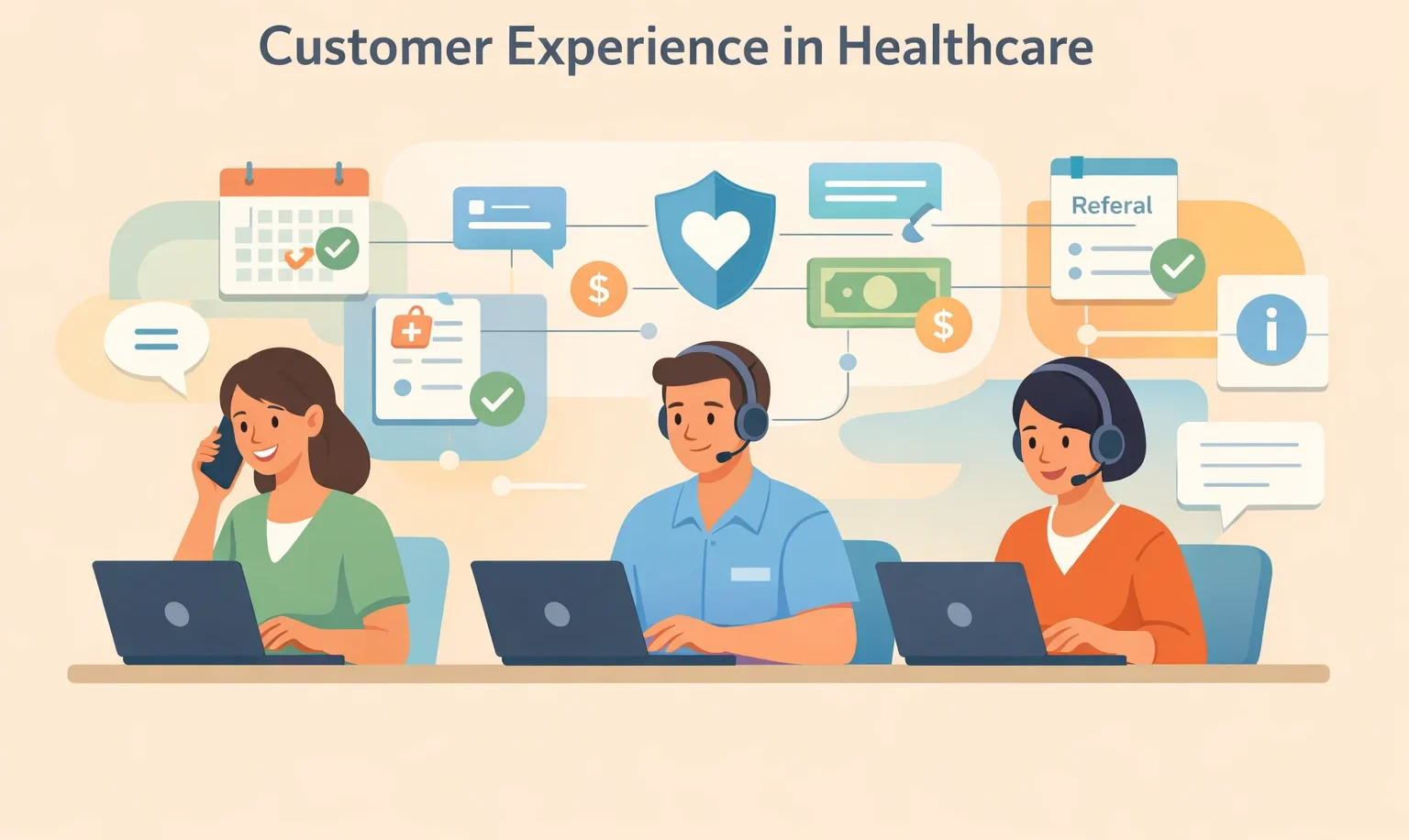


A patient calls to schedule an MRI. The scheduler says a referral is required. The patient gets the referral and calls back. A different scheduler now says insurance pre-authorization is also needed. After getting approved, a third scheduler mentions specific preparation instructions are required 48 hours before the appointment.
Three calls. Three different requirements. Each one correct, but none complete.
This is how customer experience breaks down in healthcare. Not from bad intentions, but from scattered information across teams.
Clara Don, Senior Director at UMass Memorial Health, described this problem: “We had information in so many places, and we just couldn’t get to it fast enough or consistently enough to deliver the same answer to callers.”
Most healthcare organizations store critical patient information across shared drives, emails, portals, and local job aids. When policies change, updates don’t reach every team simultaneously. The result is inconsistent answers that frustrate patients and slow down care.
This matters because patients judge their healthcare experience through these operational touchpoints.
The solution is giving frontline teams immediate access to accurate information during live patient interactions. When scheduling, billing, and care navigation teams can find the right answer in seconds, patients get consistent guidance. Wait times drop, repeat calls decrease, and trust improves.
This article explains what customer experience healthcare means and how organizations can improve it by supporting teams who interact with patients every day.
What Is Customer Experience in Healthcare?
Customer experience in healthcare is the end-to-end journey a patient has with a provider or health system. It includes every interaction, not just the medical treatment itself. Starting from finding the right service and booking an appointment, through the visit, and continuing into follow-up, billing, and ongoing support.
A helpful way to think about it is the difference between patient experience and customer experience:
- Patient experience focuses on care delivery. This includes clinical quality, bedside manner, safety, and how care is delivered during diagnosis, treatment, and recovery.
- Customer experience covers everything around the care that shapes trust and customer satisfaction. This includes access and scheduling, communication, billing and payments, support and service, and digital touchpoints like portals, forms, and messaging.
These areas matter because most patient frustration doesn’t come from clinical expertise. It comes from the operational experience around it. Patients want answers, simple next steps, and consistent guidance across teams.
Benefits of Great Customer Experience in Healthcare
Here are some benefits of great CX in healthcare:
Higher Patient Satisfaction and Loyalty
When access and communication feel smooth, patients are more likely to stay with a provider and recommend them.
Loyalty and patient satisfaction drop when operational experiences fail. A survey of 1,000 patients found 56% would switch providers after a poor billing experience, showing how much non-clinical touchpoints affect retention.
Good customer experience protects reputation and lowers the volume of repeat contacts driven by confusion or dissatisfaction.
Trust in High-Stress Moments
Patients judge care quality through what they can see and feel. They notice whether staff are aligned, instructions are clear, and next steps make sense.
This becomes critical in high-stress situations such as urgent referrals, denied coverage, discharge planning, and post-visit questions. When frontline teams have immediate access to accurate information, patients are less likely to:
- Doubt what they were told
- Escalate complaints due to conflicting answers
- Delay care because the process feels unclear.
Trust reduces friction. It lowers escalations, improves follow-through on next steps, and reduces “I was told something different” situations that slow down service.
Faster Access and Less Friction Across the Care Journey
Many patients experience issues that happen before care begins or after it ends. Delays come from missing information, unclear preparation steps, or staff needing to verify requirements during live interactions.
Healthcare organizations reduce friction when customer-facing teams can:
- Find the correct information immediately
- Follow clear and scenario-based workflows
- Avoid sending patients back and forth between departments.
Clara Don, a senior director at UMass Memorial Health described this challenge:
“We had information in so many places, and we just couldn’t get to it fast enough or consistently enough to deliver the same answer to callers.”
This is why improving customer experience starts with improving how staff access and use information. Knowledge management in healthcare, AI-assisted search, and guided workflows help teams respond faster, reduce repeat contacts, and keep patients moving through the system with fewer delays.
Streamlined Workflows That Improve Efficiency and Patient Experience
Operational efficiency plays a direct role in healthcare customer experience. When workflows are slow or inconsistent, patients experience longer waits, repeated questions, and unclear next steps.
Streamlined workflows improve CX by:
- Reducing manual data entry during intake and registration
- Giving staff clear guidance on the required information before appointments
- Standardizing referral, eligibility, and follow-up processes.
During implementation, workflow review reveals hidden issues.
“What we thought was accurate information often wasn’t. The review process showed us where things had broken down.” – Peter Gellis, UMass Memorial Health
By standardizing workflows and aligning teams around a single set of guidance, healthcare organizations focus on supporting patients rather than correcting avoidable issues.
Lower Legal and Compliance Risk for Patient-Facing Teams
In U.S., many compliance issues happen during everyday conversations with patients. Scheduling, billing, and care navigation teams handle regulated, time-sensitive topics that are easy to get wrong when guidance is outdated.
Strong customer experience (CX) reduces legal risk by keeping frontline teams aligned on current, approved information for requirements such as:
- Health Insurance Portability and Accountability Act (HIPAA) Privacy Rule
- No Surprises Act
- Emergency Medical Treatment and Labor Act (EMTALA)
- Affordable Care Act Section 1557.
When teams rely on controlled, versioned knowledge, they are less likely to quote the wrong policy, miss required steps, or give inconsistent guidance across departments and channels.
Key Stages in the Healthcare Customer Journey
In healthcare patients move back and forth between stages, revisit earlier steps, and interact with multiple teams across channels. A breakdown at any point can affect the entire experience, even if clinical care is delivered well.
Understanding this end-to-end customer journey helps explain why customer experience depends so heavily on access to consistent information across teams.
Research and Awareness
The journey starts before a patient ever contacts a provider. Patients search online for symptoms, services, locations, coverage details, and reviews. At this stage, unclear or inconsistent information can create confusion or lead patients to seek care from another provider.
If patients can’t easily understand services offered, referral requirements, or how to get started, trust is lost early.
Scheduling and Access
Scheduling an appointment is one of the most critical stages. Patients need to confirm appointment availability, referral requirements, insurance coverage, or preparation steps.
Breakdowns here lead to:
- Long wait times
- Missed or delayed appointments
- Repeat calls to clarify requirements.
Clear and consistent guidance for scheduling and access teams is essential to keep patients moving forward.
Preparation and Onboarding
Before the visit, patients need to complete forms, gather documents, follow preparation instructions, or arrive early. Confusion at this stage leads to no-shows, incomplete visits, or rescheduling.
When instructions vary across teams or channels, patients arrive unprepared and frustrated, which affects both experience and operational efficiency.
Consultation and Diagnosis
During the visit, patients expect explanations, aligned messaging, and confidence from staff. While clinical expertise is central, experience is shaped by how well information is communicated and whether next steps are explained clearly.
If staff are unsure or provide inconsistent guidance, patients leave with unanswered questions or uncertainty.
Treatment and Care Delivery
Treatment involves multiple departments, handoffs, and follow-ups. Patients may interact with nurses, specialists, care coordinators, and support staff.
Experience suffers when:
- Instructions differ between teams
- Patients are unsure who to contact
- Updates are delayed or unclear.
Consistency across care delivery teams helps reduce confusion and anxiety.
Discharge and Follow-Up
Discharge is a high-risk stage for experience breakdowns. Patients need instructions, medication guidance, follow-up timelines, and contact information. When discharge information is unclear or inconsistent, patients are more likely to:
- Call back with questions
- Miss follow-up care
- Return unnecessarily.
Standardized guidance at discharge supports safer transitions and better outcomes.
Billing, Payments, and Ongoing Engagement
For many patients, the experience does not end with care. Billing questions, payment plans, and follow-up communications often shape their final impression.
Confusing bills, unclear explanations, or inconsistent answers at this stage can overshadow the quality of care itself and damage trust long after treatment is complete.
Each stage of the healthcare customer journey is connected. A scheduling error can delay care. Poor preparation leads to wasted visits. Unclear discharge instructions create follow-up issues. Billing confusion erodes trust after care is delivered.
How Digital Solutions Are Changing Healthcare Customer Experience
Digital tools play an essential role in healthcare customer experience, but adoption remains uneven. Only about 55% of consumers interact digitally with healthcare organizations, compared to nearly 90% in industries like banking and government.
This gap affects patient experience. When digital tools are complex to use or poorly supported, patients face delays and confusion. Digital solutions improve the experience only when staff can use them confidently and when information remains consistent.
Telehealth and Virtual Care
Telehealth has expanded access to care by allowing patients to consult providers remotely. It reduces travel time, shortens wait times for specific appointments, and helps patients receive care sooner.
Customer experience depends on how well telehealth is supported. When scheduling rules, preparation steps, and follow-up instructions are unclear, patients struggle even when the visit itself is virtual. Clear guidance for staff and patients is essential to make virtual care effective.
Patient Portals and EHR Access
Patient portals and electronic health record (EHR) access give patients visibility into appointments, test results, and messages. These tools improve transparency and engagement when information is accurate and easy to understand.
Problems arise when staff and patients rely on different sources of truth. If portal information, verbal guidance, and printed instructions do not align, confusion increases. Digital access works best when staff reference the same approved information patients see.
Mobile Apps and Self-Service Tools
Mobile apps and self-service tools allow patients to schedule appointments, complete forms, and check status without calling. This can reduce call volume and improve convenience.
These tools only improve experience when clear workflows support them. If self-service options lack guidance or fail to handle common scenarios, patients return to phone or in-person support. Staff must be able to quickly resolve issues that self-service tools cannot.
Generative AI Support and Chatbots
Generative AI provides faster access to answers and extends service beyond business hours. Chatbots and virtual assistants help patients find information, complete simple tasks, or reach the right team.
Generative and conversational AI in healthcare works best when it is grounded in accurate and approved knowledge. Without that foundation, responses become inconsistent and unreliable.
Data and Analytics for Continuous Improvement
Data and analytics help healthcare organizations understand where experience breaks down. Insights from search behavior, call reasons, and common questions reveal gaps in information and process.
Using this data allows teams to update guidance, improve workflows, and reduce repeat issues. Continuous improvement depends on turning insight into action, not just collecting metrics.
Best Practices to Improve Customer Experience in Healthcare
The practices below focus on what healthcare organizations can actively implement and invest in to make CX better in real-world settings:
Reduce Wait Times Through Better Workflow Coordination
Long wait times affect both patient experience and operational performance. Delays increase call volume, extend handling time, and require more staff effort to resolve the same requests.
Reducing wait times starts with workflow coordination. Each patient-facing process needs clear ownership, defined roles, and shared information to prevent duplication or delays.
This includes:
- Defining which team owns each step
- Clarifying what information is required at each stage
- Ensuring handoffs happen in the correct order.
For example, when an appointment requires insurance verification and a referral, delays often occur because responsibilities are unclear. Scheduling books the visit, registration finds missing information on the day of the appointment, and the patient is asked to reschedule.
With coordinated workflows, scheduling confirms referral rules upfront, registration verifies insurance before the visit, and clinical teams receive complete information in advance. Check-in is faster, care starts on time, and avoidable delays are reduced.
Standardize Service Delivery Across Teams and Locations
Patients expect the same answer regardless of who they speak to or which location they visit. Inconsistent service delivery happens when teams rely on local processes, personal notes, or outdated instructions.
Standardization starts with defining approved guidance for common patient-facing scenarios and making it accessible to everyone who needs it. This includes policies, scripts, procedures, and escalation steps.
For example, if a billing policy changes, only one department updates its process. Patients calling different numbers receive different explanations. Standardizing service delivery ensures that:
- All teams reference the same approved guidance
- Updates are applied once and reflected everywhere
- Patients receive consistent answers across channels.
Knowledge management systems help enforce this by presenting one current version of guidance while keeping historical changes traceable.
Educate Patients With Accessible Information
Many CX issues stem from patients not understanding what to do next. Confusion around preparation steps, documentation, coverage, or follow-up leads to repeat calls and missed care.
Healthcare organizations should focus on simplifying patient-facing information and ensuring staff can explain it clearly. Education should be written in plain language and delivered consistently across touchpoints.
Personalize Care Plans and Communication
Healthcare is scenario-based, but many interactions are handled generically because staff lack quick access to contextual guidance. Personalization does not mean custom content for every patient. It means applying the proper rules and steps based on the patient’s situation.
This requires decision support that adjusts guidance based on factors such as appointment type, insurance, urgency, or care setting.
For example, if two patients request referrals, one is urgent, the other routine. Personalized guidance helps staff follow the correct steps for each case without guessing or escalating, improving both speed and accuracy.
Guided decision tools and structured workflows make personalization practical at scale.
Capture and Act on Patient Feedback
Patient feedback is only useful if it leads to action. Many organizations collect feedback but struggle to connect it back to operational improvements.
Effective CX programs capture feedback at key points and route it to the right teams for review and improvement. This includes complaints, comments, and recurring questions.
Invest in Staff Training and Enablement
Staff training is critical, but training alone is not enough. Frontline teams need ongoing enablement during live interactions.
Enablement includes:
- Easy access to approved information
- Clear guidance for common scenarios
- Confidence that what they see is current.
Provide 24/7 Customer Support With AI Assistance
Healthcare does not operate on a 9-to-5 schedule. Patients need answers outside standard business hours, but staffing round-the-clock support is expensive and complicated.
This is where AI-powered support can play a role alongside human teams. AI agents like Luna can provide 24/7 assistance by answering common questions, guiding patients to the right next step, or helping staff retrieve information faster during live interactions. AI support can:
- Reduce after-hours call volume
- Provide immediate responses when staff are unavailable
- Support human agents rather than replace them.
Investing in AI-driven support allows healthcare organizations to extend access while maintaining consistency and accuracy.
How livepro Improves Customer Experience in Healthcare
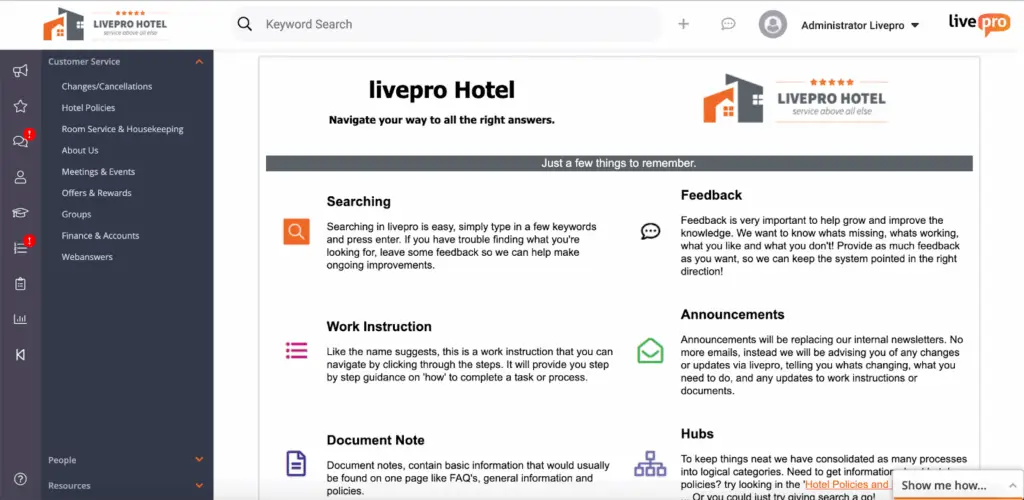
livepro is a knowledge management system built for healthcare organizations that depend on role-specific information during patient interactions. It supports customer-facing teams, including patient access, scheduling, billing, care navigation, and contact centers.
Healthcare environments are highly regulated, fast-moving, and complex. Policies change frequently, processes vary by patient context, and staff work across shifts and locations.
livepro helps healthcare teams deliver consistent and approved information by centralizing knowledge. It guides staff through complex workflows and enforces governance at scale.
Below are livepro’s key features that improve healthcare customer experience:
Find Information Faster With Lightspeed Search and Answer Articles

Healthcare teams lose valuable time searching across shared drives, PDFs, intranets, and outdated manuals to answer routine patient questions. These delays increase wait times, extend call handling, and frustrate patients.
livepro addresses this with Lightspeed Search, which helps staff find the correct answer immediately by:
- Natural Language Processing: Staff can search using full questions, such as “What documents are required for a referral?”, without knowing the exact keywords.
- Intent-Based Relevance Scoring: The system prioritizes the most relevant, approved content instead of returning long result lists.
- Search Summaries: Key information is surfaced at a glance so staff can confirm accuracy before opening an article.
Paired with Answer Articles, information is presented in short, clearly structured responses designed for live conversations, not long-form reading.
For example, when a scheduling agent searches for “MRI referral requirements,” livepro surfaces the current eligibility rules and documentation steps instantly, reducing back-and-forth with the patient.
Improve Decision Accuracy With Process Guidance and Rocket Workflows

Healthcare processes are rarely linear. Intake, referrals, escalation, discharge, and follow-up often depend on patient-specific details such as insurance type, urgency, diagnosis, or care setting.
livepro’s Process Guidance and Rocket decision tool turn complex policies into guided workflows that adapt in real time.
Here’s how it works in practice:
- Teams convert multi-step policies into decision-based workflows using a visual builder
- Staff answer simple questions, and Rocket dynamically presents the next relevant step
- The workflow adjusts automatically based on responses.
For example, a patient access coordinator handling a referral follows a guided path that adjusts based on referral urgency, payer requirements, and service location.
Keep Frontline Teams Aligned With Announcements and Alerts
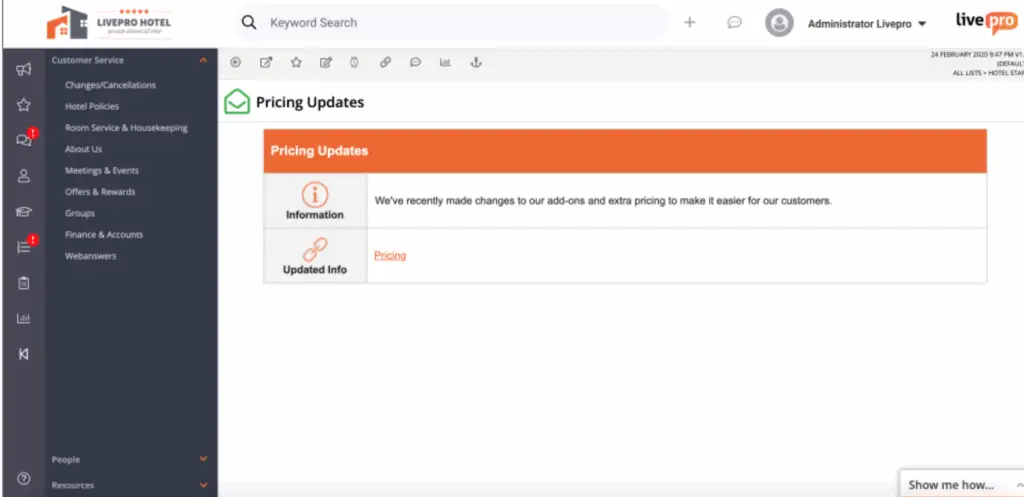
Healthcare operations change frequently, clinic hours shift, services pause, referral rules update, and temporary processes are introduced. When these updates are sent by email, they are often missed or forgotten.
livepro’s Announcements and Alerts deliver time-bound updates directly inside the knowledge experience.
These alerts:
- Appear automatically when staff access related knowledge
- Remain visible only while relevant
- Expire without manual cleanup.
For example, when a clinic temporarily suspends a service, an alert appears next to scheduling guidance so staff follow the correct process immediately.
Deliver Consistent Answers With Knowledge Articles and Structured Navigation
Patients expect consistent answers regardless of who they speak to or which channel they use.
livepro’s Knowledge Articles, supported by structured navigation, categories, and hubs, create a single source of truth for patient-facing guidance. This ensures contact centers, front desks, and digital channels use the same approved information.
This consistency reduces:
- Conflicting answers between departments
- Repeated calls caused by unclear information
- Patient frustration during handoffs.
For example, billing guidance is standardized so patients receive the same explanation whether they call, visit a clinic, or use a digital channel.
Reduce Compliance Risk With Governance, Version Control, and Review Workflows

In healthcare, customer experience and compliance are inseparable. Staff must rely on guidance that is approved, current, and traceable.
livepro’s knowledge governance framework enforces this through:
- Version Control: Every change creates a new version with a complete history.
- Visual Version Comparison: Reviewers can see exactly what changed before approval.
- Role-Based Permissions: Only authorized users can edit or publish content.
- Review Scheduling: Content is automatically flagged for review before it becomes outdated.
When a policy changes, the old version is removed from frontline view while remaining accessible for audit purposes. Staff always see the current guidance.
Identify CX Gaps With Analytics and Usage Insights
Healthcare leaders need visibility into how knowledge is used to improve experience. livepro’s analytics and dashboards show:
- What do staff search for most
- Where searches fail or are abandoned
- Which articles support faster resolution.
For example, if analytics show repeated searches around discharge instructions, teams can refine content or provide additional guidance before issues escalate.
This allows healthcare organizations to improve customer experience proactively rather than reacting to complaints.
Build Staff Confidence With Engagement and Feedback Tools
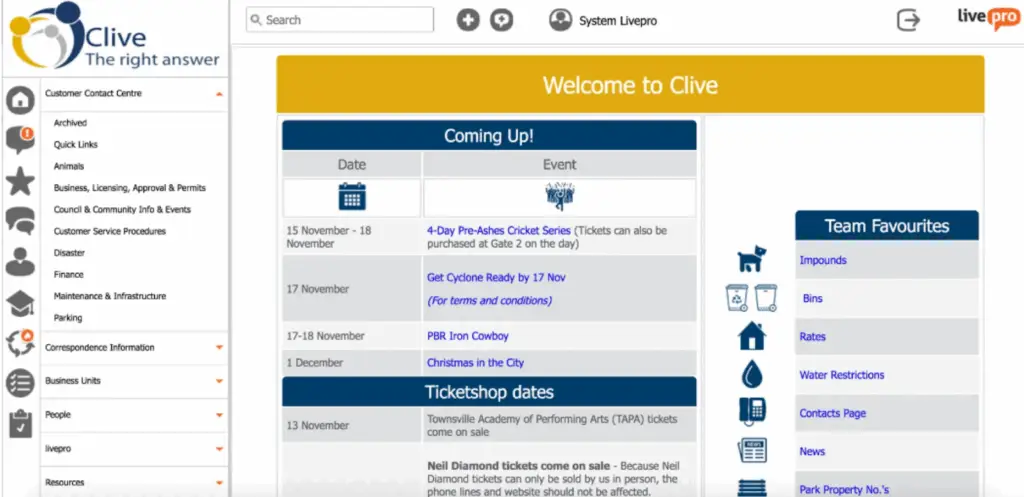
Staff confidence directly impacts patient interactions. livepro’s engagement tools, including favorites, quizzes, and feedback, help staff adopt and trust the system.
- Favorites allow quick access to frequently used guidance.
- Quizzes ensure understanding of new or updated policies.
- Feedback allows staff to flag unclear or outdated information at the point of use.
This creates a feedback loop where knowledge improves continuously based on real frontline use.
How UMass Memorial Health Improved Patient Access Consistency with livepro
UMass Memorial Health operates an enterprise-wide Patient Access Center that serves as a single point of contact for scheduling, care navigation, and access across a large and growing health system.
As the organization expanded through new hospitals, locations, and service lines, keeping patient-facing information accurate and consistent became increasingly complex.
The Problem
Patient access teams relied on a mix of SharePoint sites, spreadsheets, emails, and locally maintained job aids. Information changed frequently and was difficult to keep aligned across teams.
This created several challenges:
- Agents struggled to confirm whether the information was current
- Different teams gave different answers to the same patient questions
- Process changes were missed or applied inconsistently
- Staff relied on memory or peer support during live calls.
During periods of rapid change, such as COVID-related process updates, these issues became harder to manage at scale.
The Solution
UMass Memorial Health implemented livepro to establish a single source of truth for patient-facing knowledge. Content was centralized in a single system that staff could rely on during live patient interactions.
A key capability was Rocket, livepro’s decision guidance tool. Rocket allowed the team to turn complex intake rules, scheduling logic, and specialty-specific requirements into guided decision paths. Agents could ask a patient a question, select the response, and be guided to the correct next step.
The solution focused on:
- Centralizing knowledge so staff no longer search across tools
- Using Rocket to guide agents through complex, variable scenarios
- Standardizing how information appeared across specialties
- Controlling access so staff only saw information relevant to their role.
The Results
Frontline staff quickly adopted livepro because it was easier to use than previous tools. Agents could search for what they needed, follow guided steps, and confidently provide answers to patients.
As a result:
- Patient-facing information became consistent across teams
- Agents spent less time searching and escalating questions
- Complex calls were handled more confidently
- New staff ramped up faster without relying on informal job aids.
By making livepro the system staff naturally turned to during calls, UMass Memorial Health improved the reliability of patient access interactions and strengthened the overall customer experience.
Watch the full video “TechRX: livepro & UMass Memorial Health’s Prescription for Knowledge:”
Hear directly from healthcare leaders at UMass Memorial Health as they share how livepro helped centralize patient-facing knowledge, improve consistency, and support frontline staff during live interactions.
Ready to see how our platform can help you? Book a demo to explore how livepro supports patient access, scheduling, billing, and care navigation teams with guided workflows, governed knowledge, and role-based access.
FAQs: Customer Experience Healthcare
How Is Healthcare Customer Experience Measured?
Customer experience in healthcare is measured using patient feedback and operational metrics, such as satisfaction surveys, wait times, call resolution, no-shows, and complaint trends. These measures show how easily patients can access care and get clear answers.
How Does Technology Improve the Customer Experience in Healthcare?
Technology improves healthcare CX by reducing delays, improving access to information, and supporting consistent communication. Tools such as telehealth, portals, self-service, AI support, and analytics work best when staff rely on accurate, approved information.
Why Is a Positive Customer Experience Important in Healthcare?
A positive customer experience builds trust and improves patient engagement. Clear access and communication help patients follow care plans, reduce delays, and avoid repeat issues, benefiting both patients and healthcare teams.