

A patient calls asking if their Medicare Advantage plan covers a specific cardiology procedure. The agent opens SharePoint, scans a 47-page PDF, checks Teams for policy updates. Three minutes pass. The patient is still waiting.
This scenario repeats thousands of times each day in healthcare contact centers.
UMass Memorial Health dealt with this exact problem. Patient access center staff searched across multiple systems during every call, unable to find answers fast enough for waiting patients.
“We had SharePoint, Teams, all these different pieces of information and just couldn’t get to that information fast enough or consistent enough,” said Clara Don, Senior Director of the Patient Access Center at UMass Memorial Health.
But healthcare organizations that solve fragmented knowledge management are seeing real results. For example, Avant Mutual cut first contact resolution time in half while dropping average handle time by 20%. New agents now reach full competency in under a month instead of a year.
This article explains what a knowledge management system in healthcare is and why contact centers need more than document repositories.
Types of Knowledge in Healthcare Contact Centers
Healthcare contact center agents navigate seven distinct categories of knowledge during every shift. Each type requires different management approaches and access patterns:
Policies
Policies define the rules and standards that govern patient interactions and organizational operations. Examples include:
- Insurance Verification Rules: Which plans require referrals, which providers accept which payers, and what documentation satisfies eligibility requirements.
- HIPAA Handling Procedures: How to verify patient identity, when disclosure is permitted, and what constitutes a reportable breach.
- Escalation and Disclosure Guidelines: When supervisors must be involved, what information can be shared with family members, and how to handle medical record requests.
Policies change regularly as regulations evolve and payer contracts update. Outdated policy information creates compliance risk and operational inconsistency.
Procedures
Procedures are the step-by-step workflows agents follow to complete specific tasks. Examples include:
- Appointment Scheduling Workflows: Steps that vary by specialty, provider preference, insurance requirements, and appointment type.
- Referral Intake Steps: Different processes for internal versus external referrals, varying by specialty and payer.
- Prior Authorization Processes: Paths that depend on procedure type, urgency, and insurance carrier.
Unlike policies that establish rules, procedures guide execution. They must account for conditional logic, which static documents such as PDFs cannot handle effectively.
Clinical Reference Information (Non-Diagnostic)
Agents need clinical context without providing medical advice. Examples include:
- Medical Terminology: Correct spelling of specialties, understanding available services, and accurate call routing.
- Provider Specialties: Distinguishing between roles such as endocrinologists and nephrologists, or interventional versus diagnostic radiology.
- Service Definitions: What patients should expect from appointment types, required preparation, and typical procedure duration.
This information supports accurate communication without crossing into clinical advice.
Regulatory Requirements
Healthcare contact centers operate under multiple layers of regulation. Examples include:
- HIPAA Privacy Rules: Standards for patient information disclosure, minimum necessary access, and breach notification.
- CMS and Medicare Guidelines: Coverage rules, billing requirements, and quality reporting standards.
- State-Specific Healthcare Regulations: Additional compliance requirements that vary by location.
Regulatory knowledge must remain current, as penalties for non-compliance can be significant.
System Knowledge
Agents must navigate complex technology environments. Examples include:
- Electronic Health Record Navigation: Locating patient records, reviewing appointment history, and verifying insurance information.
- Customer Relationship Management Workflows: Call documentation, task creation, and case management.
- Insurance Portal Usage: Eligibility verification, claims review, and authorization status checks.
System knowledge becomes outdated whenever software updates or integrations change. Instructions must reflect what agents see on their screens.
Payer-Specific Rules
Each insurance payer operates differently, requiring specialized knowledge. Examples include:
- Medicare Versus Medicaid Differences: Eligibility, coverage, and billing variations.
- Commercial Payer Variations: Differences in authorization requirements, covered services, and appeals processes.
- Plan-Specific Exceptions: Rules that vary by plan type within the same payer.
Healthcare contact centers serving diverse populations must maintain accurate knowledge across many payer configurations.
Expertise and Judgment
Not all situations fit documented workflows. Examples include:
- Complex Scenarios: Cases involving conflicting rules or potential exceptions.
- De-Escalation Guidance: Managing frustrated callers and maintaining professionalism.
- Exception Handling: Applying judgment when procedures do not fully address the situation.
This experiential knowledge develops over time but can be supported through decision trees, scenario-based guidance, and clearly defined escalation criteria.
Why Healthcare Contact Centers Struggle with Knowledge Management
Here are some of the challenges contact centers in the healthcare industry face:
Staff Turnover and Training Complexity
Healthcare contact centers face higher turnover than most industries, with 30% to 45% of staff leaving each year. New agents need four to six weeks of training before they can handle calls independently.
During training, they learn policies, systems, workflows, compliance requirements, medical terminology, and payer rules all at once. Traditional methods like shadowing, classroom sessions, and reference binders overwhelm new hires with too much information too fast.
This creates two problems. First, experienced agents spend more time answering questions than handling calls. Second, training becomes an ongoing expense as staff constantly cycle in and out.
The real issue gets worse when knowledge lives only in the heads of experienced agents. When tenured staff leave, that institutional knowledge walks out the door with them.
Knowledge Fragmentation Across Systems
In large teams, knowledge is often spread across electronic health records, customer relationship management systems, shared network drives, PDFs, wikis, collaboration tools, and email archives.
Agents spend valuable time during live calls searching across multiple systems. Different sources provide conflicting answers, and it is unclear which version is current. Updates made in one location don’t propagate to others.
This fragmentation leads to an informal “ask your neighbor” culture, where teams rely on personal job aids and undocumented practices.
HIPAA Compliance and Audit Requirements
HIPAA requires healthcare organizations to track who accessed patient information, when, and why. Records must be kept for six years. All policy changes must be documented with timestamps and approvals.
Manual tracking creates gaps. Access goes unlogged. Changes lack documentation. During audits, organizations scramble to reconstruct records that should exist automatically.
Role-based access controls add complexity. Agents need access to do their jobs, but only to relevant information. Across fragmented systems, this is hard to enforce. Too much access creates compliance risk. Too little access blocks work.
HIPAA violations are expensive. Penalties reach $50,000 per violation, with annual maximums of $1.5 million per category. Breaches also damage patient trust and reputation.
Complex and Conditional Workflows
Healthcare workflows are rarely linear. Insurance verification depends on plan type, provider network status, and referral requirements. Scheduling rules vary by specialty, location, provider preference, and insurance constraints. Prior authorization steps change based on procedure, urgency, and payer.
Static procedures documented in Word files or PDFs can’t handle this conditional logic effectively. Agents must mentally process multiple decision paths while patients wait. Errors occur when conditions are missed or rules are applied incorrectly.
As organizations grow, merge, or add services, complexity increases. Each new specialty, provider network, or location introduces additional variations that must be reflected in agent knowledge.
Patient Experience Impact
Failures in knowledge management directly affect patient experience. Inconsistent answers reduce trust. When one agent confirms coverage and another denies it, patients question the organization’s reliability. Longer hold times increase abandonment as agents search for information.
Low first-call resolution leads to repeat contacts, increasing call volume and operational costs. Each additional interaction creates another opportunity for frustration and dissatisfaction.
Healthcare consumers increasingly expect quality customer service experience. They expect timely answers, consistent information, and efficient resolution. Knowledge management gaps create experience shortfalls that can drive patients to competing providers.
AI’s Role in Healthcare Knowledge Management
Healthcare contact centers are turning to AI for a simple reason: agents can’t find information fast enough.
Traditional knowledge bases force agents to search, read, and interpret during live calls. AI changes this. Natural language processing understands “Medicare hip auth” without requiring exact phrases like “Medicare Advantage prior authorization orthopedic procedures.” Agents ask questions naturally and get direct answers.
This matters because healthcare AI adoption jumped sevenfold in one year. Today, 22% of healthcare organizations use domain-specific AI tools, up from 3% in 2023. The spending backs this up: healthcare AI investment hit $1.4 billion in 2025, nearly triple the previous year.
But AI in healthcare knowledge management goes beyond search. Agentic AI guides agents through complex workflows with conditional logic. Instead of retrieving a document about prior authorization, the system walks agents through the exact steps based on the patient’s plan, procedure type, and urgency. More than 90% of healthcare leaders plan to prioritize this within 24 months.
The challenge isn’t capability. It’s trust and privacy. When asked why they avoid generative AI for health purposes, 30% of consumers cited lack of trust. For large healthcare organizations, data privacy represents the primary barrier to adoption. This is why purpose-built healthcare knowledge management systems matter. They combine AI capabilities with the compliance controls healthcare requires.
livepro Helps Healthcare Contact Centers Find Answers in Seconds
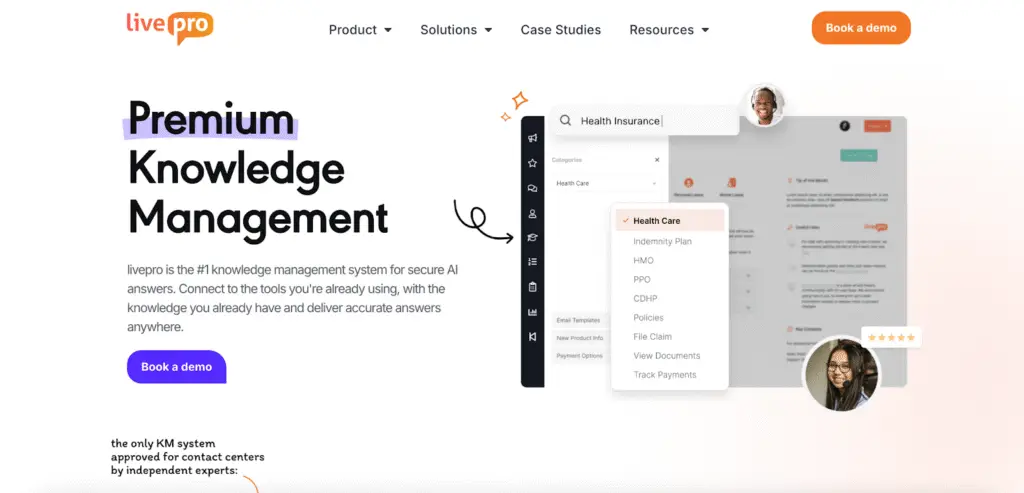
livepro is an AI-based knowledge management system for contact centers in the healthcare industry. Our software helps organizations address specific challenges with compliance, complex workflows, and information access.
Here are some of livepro’s key features that make it a top AI knowledge management software for healthcare contact centers:
Lightspeed Search for Direct Knowledge Access
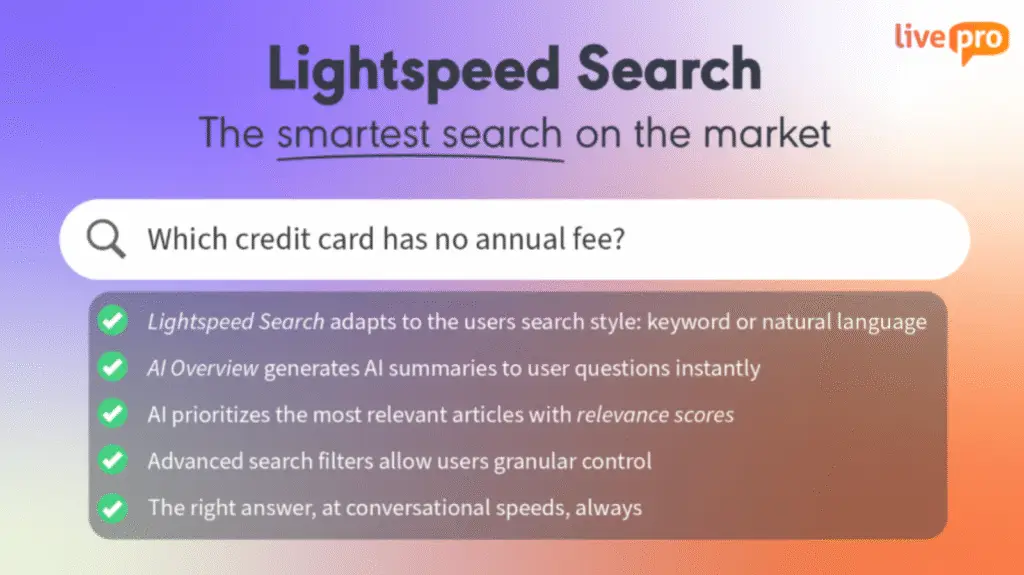
Traditional knowledge bases force agents to interpret lengthy documents during live calls. This extends Average Handle Time and increases the likelihood of errors.
livepro’s Lightspeed Search returns exact answers instead of documents to search through. When an agent queries “Aetna prior auth cardiology,” the system displays the specific answer in one concise paragraph rather than linking to a 20-page authorization manual.
Key capabilities include:
- Natural language search that understands healthcare terminology and abbreviations
- Exact answers formatted for immediate use during calls
- Confidence scores showing answer relevance
- Source citations linking to complete policy documents when needed
- Search history and analytics showing what agents look for most.
Rocket Decision Trees Guide Complex Healthcare Workflows
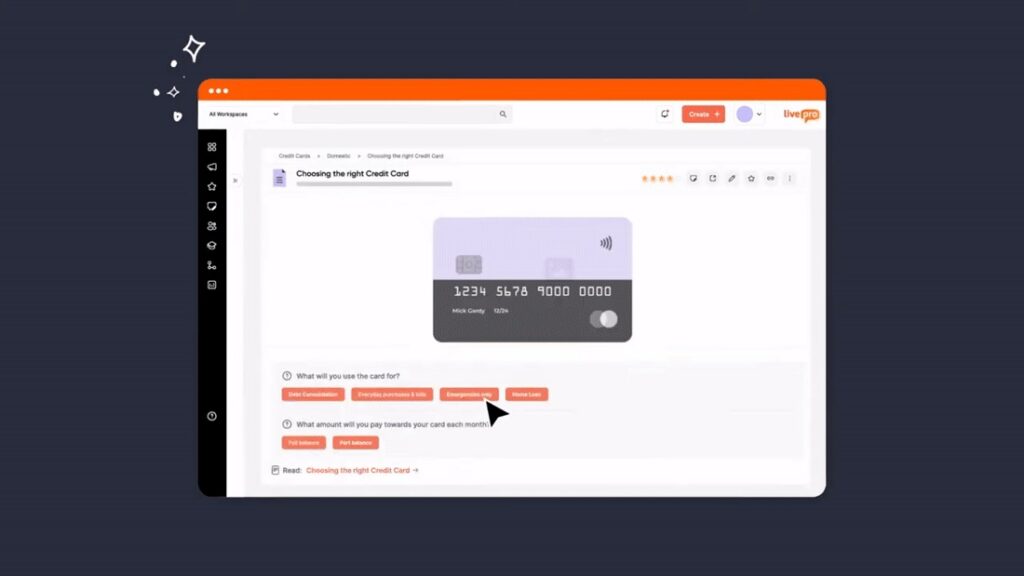
Healthcare workflows rely on conditional logic that static standard operating procedures can’t support. Insurance verification, scheduling, and prior authorization all change based on plan, provider, urgency, and payer.
livepro offers Rocket that guides agents through complex workflows with dynamic and branching logic.
Here’s what you get:
- Visual workflow builder for creating branching logic without coding
- Question nodes that adapt based on previous answers
- Embedded knowledge articles at decision points
- Automated documentation of the path taken for quality assurance
- Version control showing workflow changes over time
- Analytics showing where agents exit or repeat steps
Peter Gellis, Process Improvement Manager at UMass Memorial Health, called Rockets “a bit of a game changer for us and probably the most appreciated function.” The branching logic mimics how experienced agents think through problems while documenting the decision process for new hires.
Automatic Audit Trails Support HIPAA Compliance
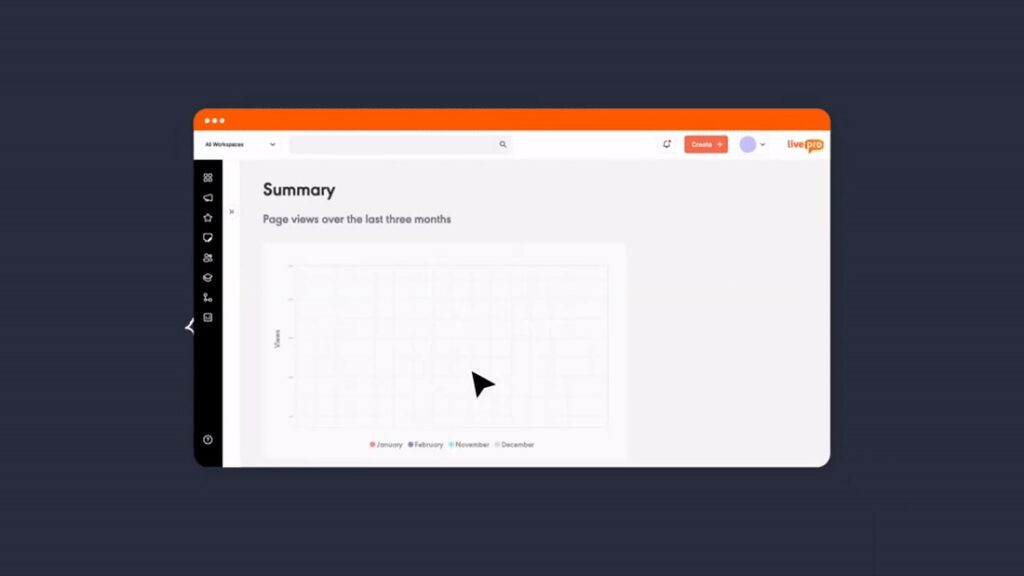
livepro automatically captures every knowledge access, search query, article view, and content update with timestamps and user attribution. These audit trails generate in real-time without requiring any action from agents or administrators.
Here’s what automatic audit trails track:
- Every search query with timestamp and user ID
- All article views and time spent on each page
- Content edits with before/after comparison
- Access attempts for restricted content
- Export and sharing activities
- Failed login attempts and security events
For example, during a HIPAA audit, a compliance team can generate a report showing who accessed a billing policy, when it was viewed, and which unauthorized access attempts were blocked, allowing the audit to be completed without manual records.
Version Control to Prevent Outdated Guidance
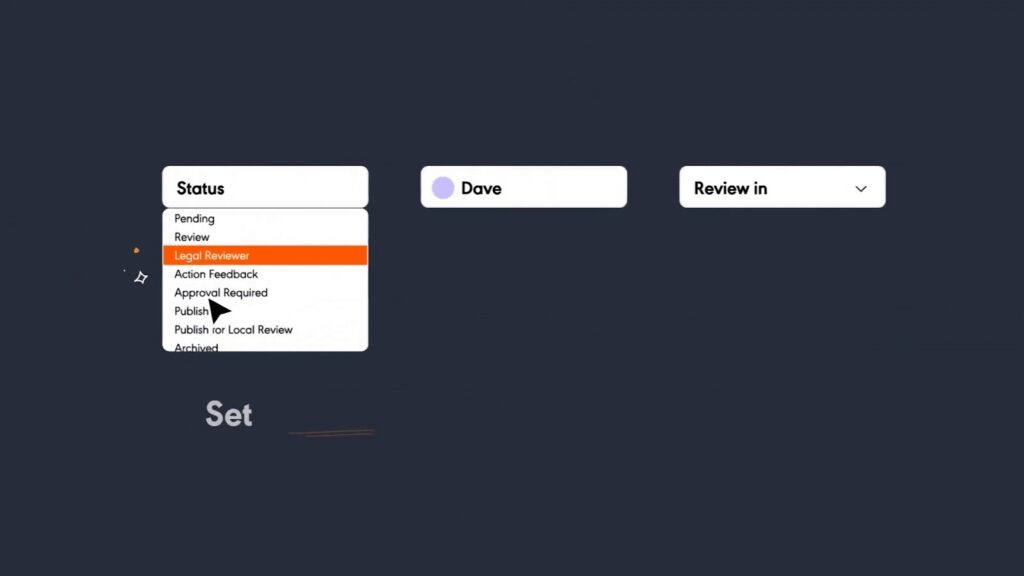
Healthcare policies and procedures change frequently as regulations evolve, payer contracts update, and organizational standards adjust.
livepro’s version control system maintains complete history of all knowledge changes, displays visual comparisons between versions to highlight exactly what changed, and schedules automatic review reminders.
For example, when Medicare updates prior authorization requirements for durable medical equipment:
- A knowledge manager updates the relevant article in livepro
- The system saves the previous version and shows a side-by-side comparison of added and removed requirements
- A review reminder is scheduled to confirm the policy remains current
- During the next audit, the compliance team exports version history showing the update timing and review activity.
PII Redact Protects Patient Privacy
Manual redaction of personally identifiable information is time-consuming and inconsistent. Staff may accidentally include patient names, dates of birth, medical record numbers, or other sensitive data when sharing information.
livepro’s PII Redact feature automatically detects and redacts personally identifiable information before content is shared or exported. The system identifies common PII patterns including:
- Names
- Dates of birth
- Social Security numbers
- Medical record numbers
For example, a training manager exports patient interaction transcripts through livepro, where PII Redact automatically removes sensitive details. It replaces “Mrs. Johnson, DOB 3/15/1967, MRN 445821” with “[PATIENT NAME], DOB [REDACTED], MRN [REDACTED]” while keeping the clinical context intact.
Role-Based Permissions Enforce Minimum Necessary Access
In healthcare contact centers, different roles require different information access.
- Scheduling agents need appointment-related knowledge but shouldn’t access billing procedures.
- Billing specialists need payment policies but shouldn’t access clinical reference information.
Implementing granular permissions across fragmented systems becomes nearly impossible, leading to either over-permissioning that creates compliance risk.
livepro enables granular, role-based permissions at the content level. Administrators define roles aligned with job functions, assign specific knowledge access to each role.
Clara Don from UMass Memorial Health noted that having “permissions based on that” ensures “if they’re not skilled to take that call type, they won’t have the information and knowledge on that call type.”
As a result, agents interact only with information tied to their role, lowering compliance risk and unnecessary access.
How Avant Mutual Reduced Training Time by 85% with livepro
Avant Mutual is a medical defense organization providing professional indemnity insurance for healthcare professionals across Australia. Their contact center supports members with policy questions, claims assistance, and professional liability guidance.
All these services require deep knowledge of complex insurance products and healthcare regulations.
The Challenge
Avant Mutual had no centralized knowledge base. Information was scattered across multiple systems, shared drives, and tribal knowledge held by experienced agents. New agents relied on an “ask your neighbor” culture to find answers during calls, leading to inconsistent service quality and extended training times.
New hires also required three months of training before they could handle calls independently. Even after training, agents struggled to find accurate information. This fragmentation meant the same question could receive different answers depending on which agent responded.
The Solution
Avant Mutual implemented livepro as their healthcare knowledge management system. The organization consolidated information from multiple sources into a single and searchable platform accessible to all contact center agents.
They documented workflows, policies, and procedures in consistent formats using livepro’s content structure:
- Complex decision trees guided agents through conditional scenarios.
- Version control ensured only current policies remained accessible
- Role-based permissions matched knowledge access to job responsibilities.
The Results
The transformation happened fast. Training time dropped 85%, from three months to just two weeks. But the real story showed up in daily operations.
Average handle time fell 20%. First contact resolution jumped from 50% to 67%. Transfers dropped 33%. Wrap-up time plummeted from 17 minutes to 7 minutes.
The numbers revealed something deeper: agents stopped relying on colleagues and started trusting the system. Customer satisfaction rose 5%. Employee satisfaction climbed 13%. When customers weren’t happy, agents could now retain 70% of them, up from just 40%.
Speed to competency told the clearest story. New agents reached full productivity in under a month instead of a year.
Andrea Pepper-Edwards, Change Specialist at Avant Mutual, said it plainly: “Almost immediately, new starters using livepro performed significantly better than existing staff using our old system.”
The pilot team created internal demand. Word spread so fast that other call center staff started requesting access before the rollout was complete.
Bottom Line: livepro is the Best Knowledge Management Software for Healthcare Contact Centers
Healthcare contact centers face mounting pressure from three directions:
- Tightening HIPAA requirements
- Rising patient expectations for instant answers
- Annual staff turnover and training expenses.
In TechRX 2025’s, UMass Memorial Health showed how livepro improved knowledge access, supported consistent patient communication, and strengthened operational alignment across departments. Watch the session to hear how they rolled it out, what worked, and why they chose livepro as their system of record.
Ready to reduce training time and standardize patient answers? Book a demo to see how livepro centralizes healthcare knowledge for faster, more compliant service.
Frequently Asked Questions About Knowledge Management System in Healthcare
How does knowledge management affect agent training and turnover in the healthcare industry?
High turnover makes long training cycles expensive and unsustainable. A centralized knowledge management system shortens onboarding by giving new agents guided access to workflows and approved answers, reducing reliance on shadowing or “ask your neighbor” practices.
Can knowledge management systems identify gaps in healthcare knowledge?
Traditional systems show basic usage metrics but rarely reveal where knowledge fails. More advanced platforms like livepro can highlight unanswered searches, low-engagement content, and workflow friction, allowing teams to address gaps before they impact patients or compliance.
How do healthcare organizations measure ROI from knowledge management?
Organizations track reduced training time, lower average handle time, higher first call resolution, and fewer compliance incidents. Most see the fastest returns in onboarding efficiency and call-handling speed. Learn how to calculate knowledge management ROI for your contact center.
When should a healthcare organization invest in a dedicated knowledge management system?
Organizations typically invest when they face rising training costs, inconsistent patient answers, audit pressure, or agent burnout. At that point, knowledge management becomes operational infrastructure rather than a support tool.