
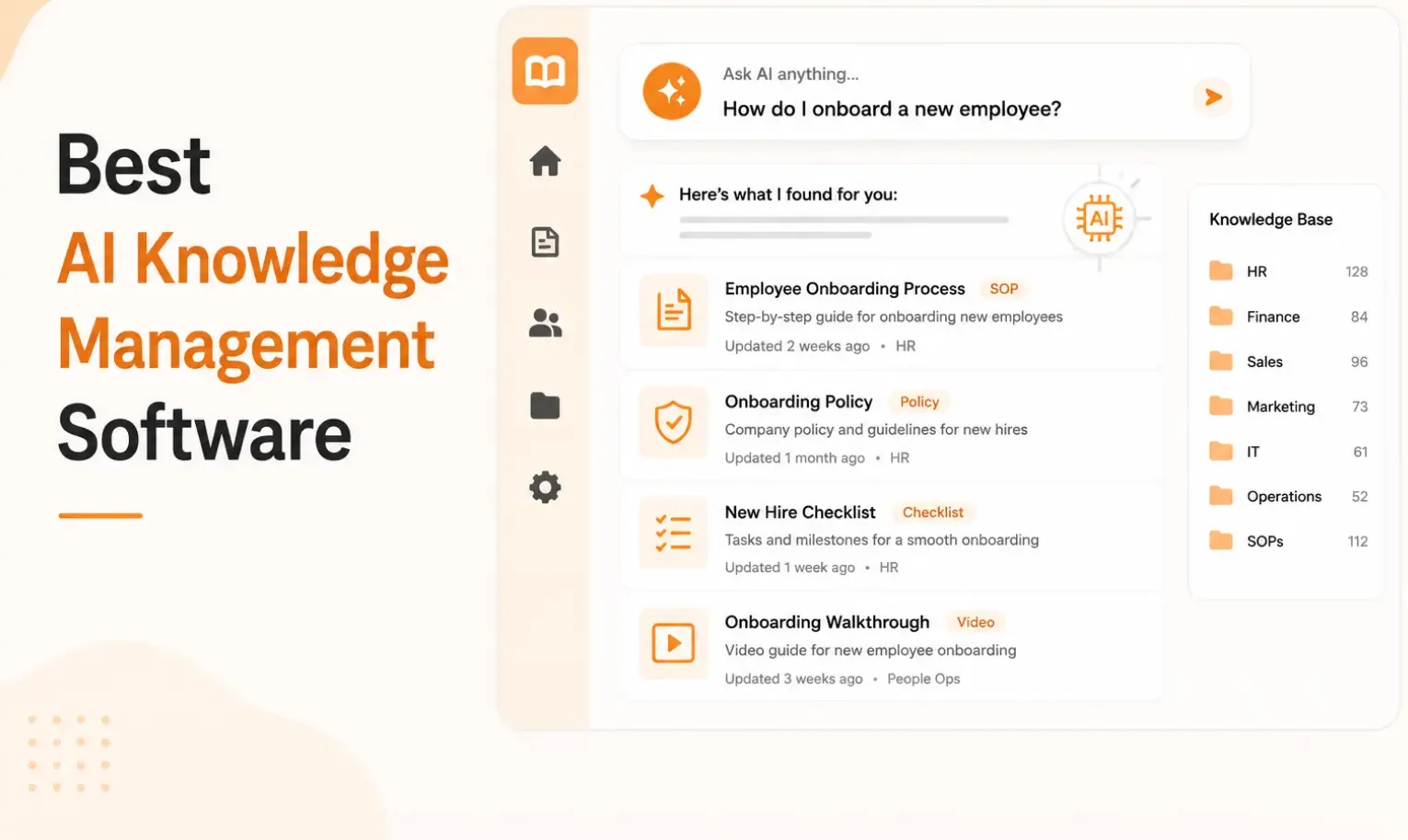


Your knowledge base has the answers. Your employees just can’t find them fast enough. That’s what the right AI knowledge management software fixes. It understands what someone is searching for, even when they don’t use the exact right words, and pulls the correct answer in seconds from content your team has already approved.
For contact centers, that means agents stop putting customers on hold to dig through outdated folders. For enterprise teams in HR, finance, or operations, it means every department works from the same verified source instead of guessing which version of a policy is current.
To help you find the right fit, we reviewed 10 of the best AI knowledge management tools for 2026, covering everything from purpose-built contact center platforms to flexible enterprise wikis.
TL;DR
- AI knowledge management software uses NLP, semantic search, and generative AI to help teams find and govern knowledge at scale.
- The 10 best AI knowledge management software options in 2026 are livepro, Guru, Bloomfire, Document360, Confluence, Microsoft 365 SharePoint + Copilot, Notion, Slite, Tettra, and Helpjuice.
- Only 27% of contact centers have integrated AI into knowledge management, according to CMSWire. Most fall short because they picked the wrong tool.
- Contact centers and enterprises in regulated industries have compliance requirements that most general-purpose tools aren’t built to handle.
- livepro is designed for contact centers and enterprises. It combines AI-powered search, compliance workflows, step-by-step decision trees, and features that automatically hide sensitive customer data before it can be shared.
What Is AI Knowledge Management Software?
AI knowledge management software gives businesses one place to store, organize, and find internal knowledge. That includes policies, processes, product information, compliance documents, and anything else employees need to do their jobs.
It goes beyond storage. The best platforms include approval workflows so outdated content never reaches employees, version control so teams can track what changed and when, and AI search so people find what they need without guessing the right keywords.
In practice, support agents find accurate answers while still on a call. HR teams share policies knowing they’re current. And operations leaders standardize processes across locations so every team follows the same procedures.
AI-Based Knowledge Management Software Vs. Traditional Knowledge Base
A traditional knowledge base is a document library with a search bar. You tag content manually, employees type in keywords, and if those keywords don’t match what’s in the document, the search returns nothing useful.
For example, an agent searching “customer wants money back” might get no results because the policy document says “refund.”
AI knowledge management software understands the intent behind a search query, so “customer wants money back” and “refund policy” lead to the same result.
How Does AI Knowledge Management Software Work?
Several technologies work together to make AI knowledge management software function. Each solves a specific problem, so the software understands what an employee is asking and surfaces the right answer.
- NLP (Natural Language Processing): Lets the system comprehend typos and conversational phrasing rather than matching exact keywords. Vector search converts text into mathematical representations and finds answers based on meaning and context. An agent searching for “claim rejected” can get results about “coverage denial” even if the document never uses the word “rejected.”
- Generative AI: Can summarize long documents, draft new knowledge articles, detect outdated content, and answer questions in plain language. Not every implementation gets this right, though. Some systems generate answers from whatever training data they were built on. The better ones only pull from content your team has reviewed and approved.
- RAG (Retrieval-Augmented Generation): Connects a generative AI model directly to your knowledge base. It pulls answers from your approved internal content and attributes every answer to a specific document.
10 Best AI Knowledge Management Software in 2026
Some AI knowledge management software are purpose-built for contact centers and enterprises in regulated industries.
Others are designed for sales teams, internal wikis, or customer-facing help centers.
The 10 tools reviewed in this guide cover the full range, so you’ll find an option that fits your situation regardless of your team size or industry.
| Software | G2 Rating | Starting Price | Free Trial | Best For |
| livepro | 4.8/5 | Custom pricing | Talk to sales | Contact centers and enterprises in regulated industries |
| Guru | 4.7/5 | Talk to sales | Talk to sales | Sales and GTM teams needing in-workflow answers |
| Bloomfire | 4.6/5 | Contact sales | No | Large teams needing deep search across all content types |
| Document360 | 4.7/5 | Contact sales | Yes | Teams building structured knowledge bases for product documentation, customer support, or internal use. |
| Confluence | 4.1/5 | Free (up to 10 users) | Yes | Dev and product teams in the Atlassian ecosystem |
| Microsoft 365 SharePoint | 4.0/5 | From $12.50/user/month (M365) | Yes | Enterprises already committed to Microsoft 365 |
| Notion | 4.6/5 | Free | Yes | Cross-functional teams wanting flexible wikis and databases |
| Slite | 4.6/5 | $10/user/month | Yes (14-days free trial) | Remote and async teams needing clean documentation |
| Tettra | 4.7/5 | $8/user/month | Yes | Small teams that live in Slack |
| Helpjuice | 4.7/5 | $249/month | Yes | Teams that need a branded knowledge base for customers, employees, or both. |
livepro
G2 rating: 4.8/5
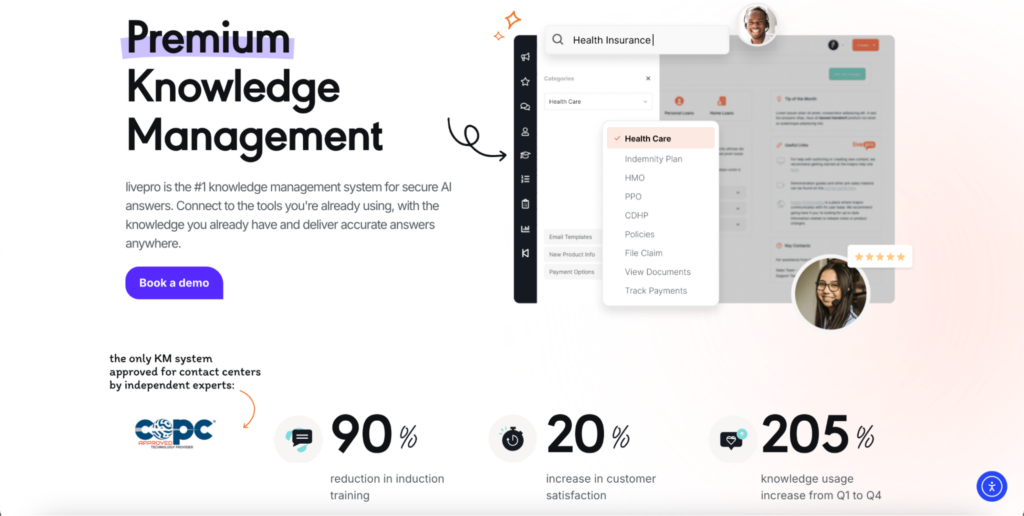
livepro is an AI knowledge management software built specifically for contact centers and enterprises in regulated industries. In G2’s Spring 2026 Grid Report, it was ranked among the top contact center knowledge base platforms, with key strengths in data governance, intelligent search, analytics, and compliance. The platform also covers AI content authoring, decision tree guidance, customer self-service, and voice AI for teams where an incorrect answer during a customer interaction has real operational and regulatory consequences.
The feedback from verified G2 reviewers reflects this. Kristin S., a Sales Operations Analyst at SafeStep, described what happened after her team launched livepro: agents stopped typing questions into chat channels where answers get buried and started searching livepro instead.
In her words, livepro became “the Google for SafeStep.” Agents told her directly: “This is the first time I’ve been able to search and find what I needed in real-time.” Adoption was higher than the team expected because the tool worked under pressure.
What makes livepro different is how each feature connects back to faster resolution times, stronger compliance, and lower operational risk:
Lightspeed Search for Fast and Accurate Answers
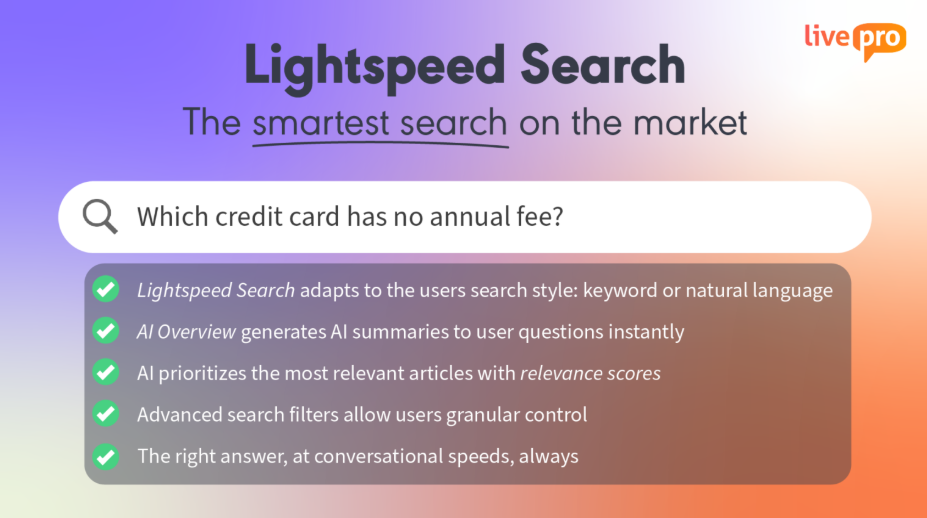
livepro’s Lightspeed Search combines keyword matching, NLP, and vector-based semantic search in a single experience. This helps it understand what an agent is looking for, even when the words they use don’t match what’s in the knowledge base.
If a query says “cancel” where the document says “terminate,” the system still finds the right article. For TSA Group, that level of search accuracy translated into a 58% reduction in agent search time after switching to livepro.
Generative AI Search: RAG-Powered, Hallucination-Free
When AI tools pull answers from general training data, they can return wrong answers. In a contact center, that means an agent sharing outdated information with a customer or, worse, giving a response that breaches compliance.
livepro’s Generative AI Search only draws from verified, approved content in your knowledge base and attributes every response to a specific source document. If the answer isn’t in the system, it says so rather than guessing.
If your agent asks a question about a customer’s refund eligibility, the answer comes back in seconds from the latest approved policy. The agent knows exactly where it came from and can share it with the customer confidently.
AI Authoring for Consistent Content
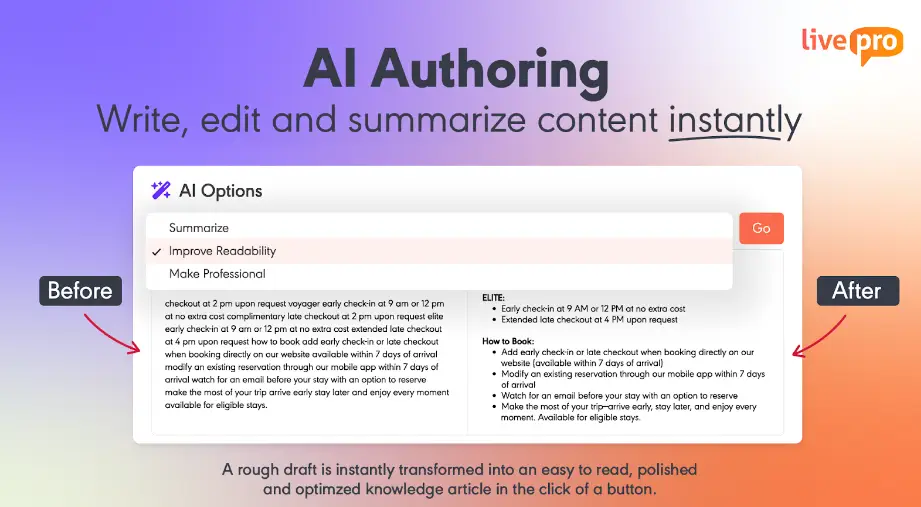
Policies and process documents are often written by subject matter experts in technical language, and the employee on the other end has to make sense of it all on the spot. livepro’s AI Authoring tool fixes this by simplifying complex language and restructuring content without the author rewriting from scratch.
You can upload a raw PDF or paste in a rough draft, and the AI improves the language and structure so the content reads clearly to whoever needs it. Jessica O., a Process Coordinator, noted this in her verified G2 review: “The AI Writer is great for rewriting articles that may be too wordy or unclear, making the information more concise and user-friendly.”
Source Documents and LightspeedAI for Legacy Content
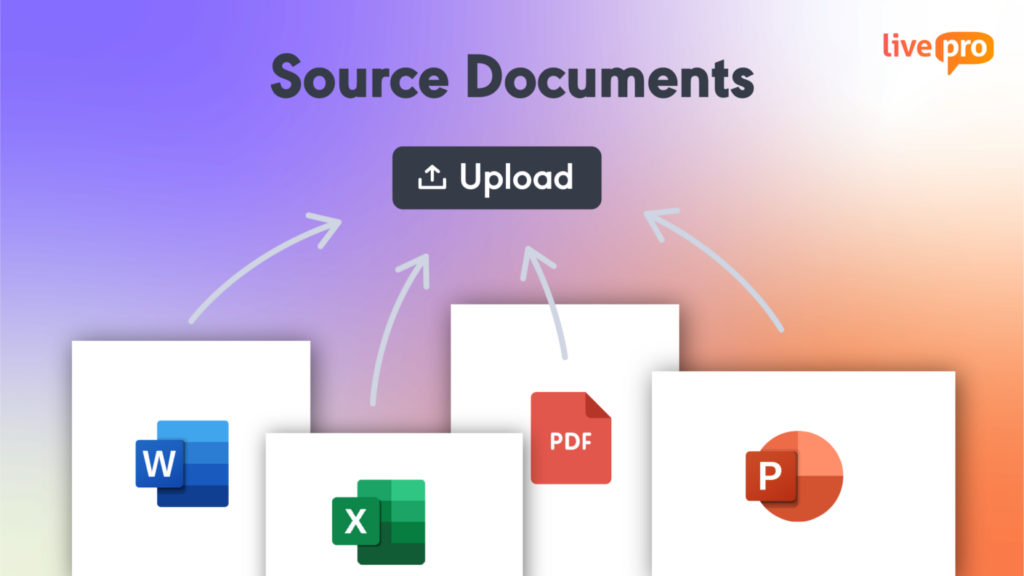
Getting useful answers from a knowledge base depends on what’s in it. The problem is that most of the content employees actually need is sitting in PDFs, Word files, and shared drives that were never connected to the knowledge system.
With the Source Documents feature, you can upload existing files directly into livepro and LightspeedAI indexes them automatically. Employees can then search across uploaded documents and authored articles in one place.
For example, if you have a 60-page product manual, you upload it once, and anyone searching for a specific process finds the relevant section in seconds.
Decision Trees for Live-Call Process Guidance
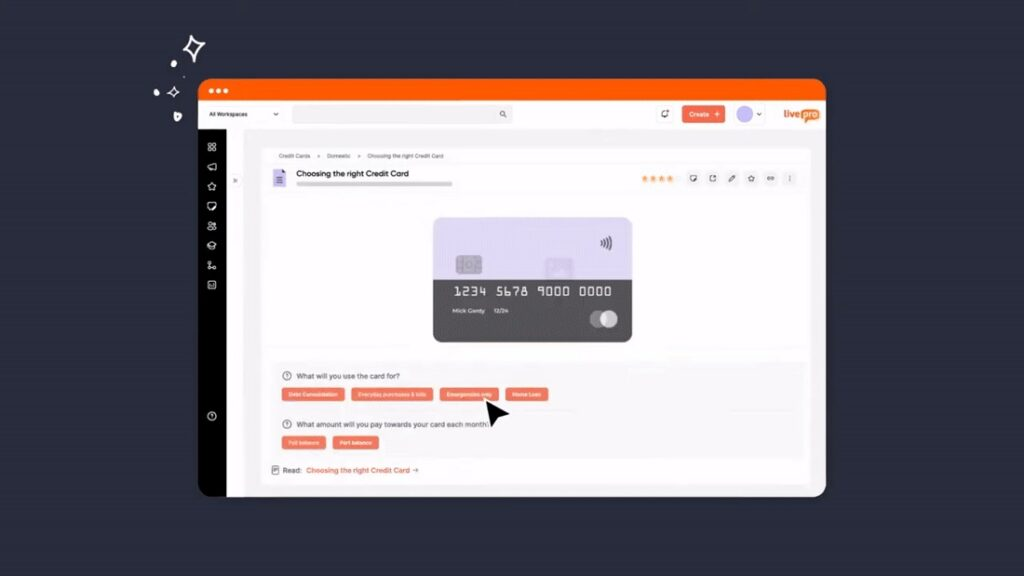
Contact center agents handle dozens of different calls every day. Expecting them to memorize the correct process for each one is unrealistic. livepro offers Decision Trees called Rockets. It guides agents through each step of a live call until the interaction reaches a resolution.
For example, take a customer calling to dispute a charge. Without a structured process, the agent relies on memory and risks missing a critical step. With Rockets, they follow a guided flow that asks the right questions in the right order and always ends with a specific action.
Jessica O. described them in her review as “an absolute game changer” that “takes out the guesswork and gives agents confidence when handling detailed or technical customer questions.”
Built-in Governance, Audit Trails, and PII Redaction
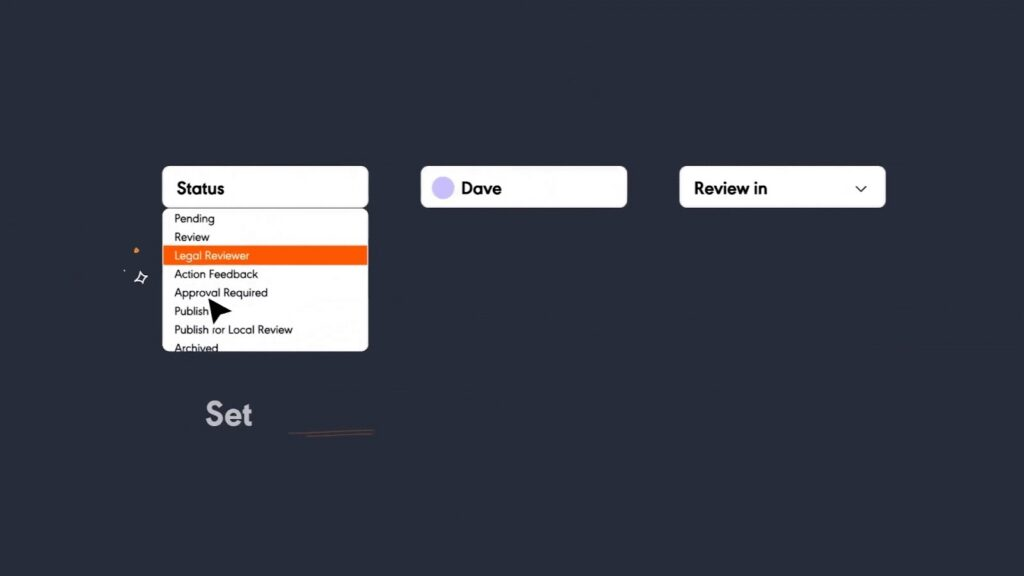
When a policy changes in your organization, you need to know that the right people approved it and that nothing sensitive slipped through before it went live. Without that control, you’re one outdated document or customer privacy breach away from a serious compliance issue.
livepro’s governance and PII redaction features mean every piece of content moves through a structured approval workflow before your agents can see it. All changes are logged automatically, and role-based permissions guarantee only approved teams have access to specific files.
livepro also scans articles and notes for sensitive customer data, like names, account numbers, and payment details, and removes anything it finds before it can be shared or published.
Customer Self-Service via External Knowledge Delivery
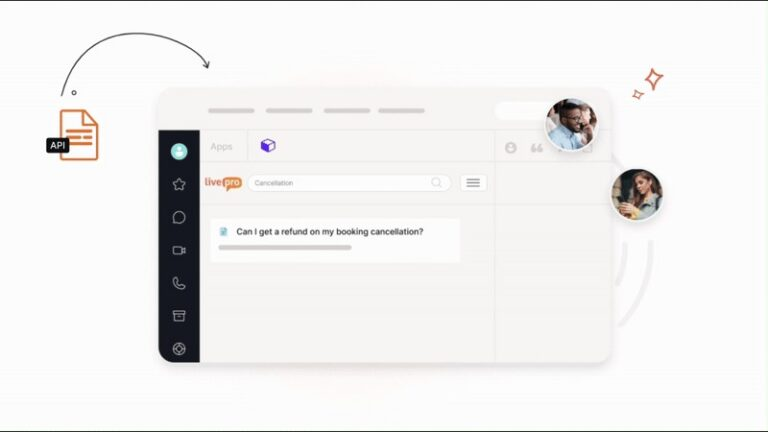
Customers who can’t find answers on their own call your contact center. That drives up call volume and puts pressure on agents who are already managing live interactions.
With livepro’s API, you can publish your internal knowledge base content on your website, giving customers access to the same verified answers your agents use. You don’t need to build a separate portal or maintain duplicate content, and there’s no risk of your customers finding an outdated policy your agents have stopped using.
For example, if your customers keep calling about how to use a specific feature on your website, you publish those help articles directly from your internal knowledge system. Customers get the answer themselves, and your contact center handles fewer repeat calls.
Luna AI Voice Agent for After-Hours Calls

Luna is livepro’s AI voice agent, built to handle inbound customer calls outside business hours. It draws answers directly from the verified knowledge base and handles routine queries independently. For more complex issues, Luna recognizes when a human agent is needed and hands the call over with the full conversation already captured.
It’s a practical extension of customer service knowledge management into the hours when no agent is available, so customers get accurate, policy-approved answers at any time of day.
AI Analytics to Track Knowledge Gaps and Usage
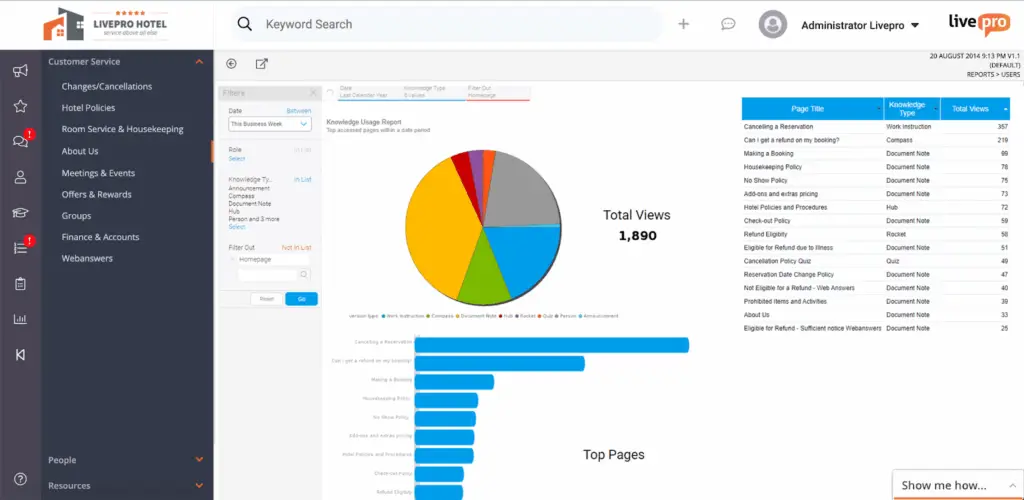
livepro’s AI Analytics dashboards give managers visibility into which articles agents access most, which searches return no results, and where agents are spending time without finding what they need. That data tells content teams exactly where to focus before gaps start affecting customer interactions.
Pros
- Fast, accurate search that agents can use during live calls without losing pace
- Governance and compliance features are built in
- Support team consistently rated as responsive and helpful across G2
- Measurable impact on AHT (Average Handling Time) and onboarding time backed by named customer results
- Integrates with Salesforce, Zendesk, Microsoft Teams, Genesys Cloud, NICE CXone, Slack, and more, with an open API for custom integrations
Cons
- Can feel overly structured for teams that need quick, informal answers
- New admins face a learning curve when building decision trees, but the customer support is there to help
Pricing: livepro offers three custom pricing plans. You can contact us for a quote.
Guru
G2 rating: 4.7/5
Guru is built around one idea: your team shouldn’t have to hunt for answers across Slack threads, Google Docs, and email chains. The platform sits inside the tools your team already uses, surfaces verified answers in context, and keeps those answers current through a card-owner verification system.
G2 reviewers consistently highlight the Chrome extension and Slack integration as the features that make it stick in day-to-day use. For sales teams, the practical win is that reps get current product positioning and objection-handling content without leaving Salesforce or chasing the latest update from a colleague.
Anna M., Director of HR at FoodCorps, described it in her verified G2 review as an “essential intranet replacement,” noting that the search function is “comprehensive and easy for new employees to use with simple inquiries like ‘benefits’ or ‘policies.'” That kind of onboarding experience is where Guru tends to win over new teams.
Learn more: Guru Alternatives
Key Features
- AI Knowledge Agents deliver cited and verified answers inside Slack, the browser, and CRM tools
- Knowledge Cards with assigned owners and freshness dates; each card gets verified on schedule or is flagged as potentially outdated
- Browser extension that surfaces relevant knowledge across any web-based tool without switching tabs
- Integrates with Salesforce, HubSpot, Zendesk, Slack, Microsoft Teams, and Google Workspace
- Analytics track card engagement, verification rates, and knowledge gaps
Cons
- Managing large content libraries requires regular organization to keep information current
- AI responses can occasionally be inaccurate, which is a risk in fast-moving sales environments
- Advanced search requires precise keywords, which makes it harder for new users to find what they need right away
Pricing
Guru offers custom pricing based on organizational scale and knowledge complexity.
Bloomfire
G2 rating: 4.6/5
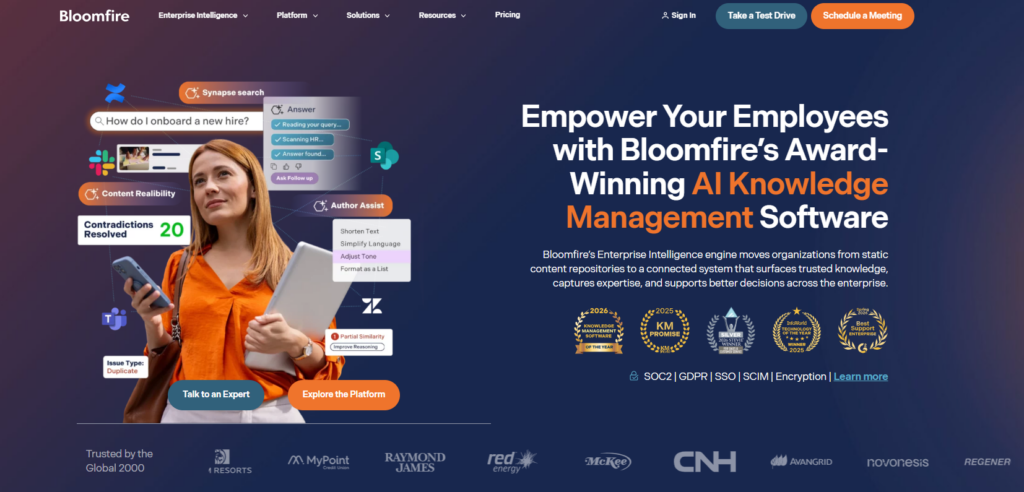
Bloomfire is built for teams whose knowledge doesn’t live entirely in text documents. It indexes PDFs, spreadsheets, presentation decks, and the spoken words inside video and audio recordings. With this, a recorded training session or all-hands call becomes just as searchable as a written policy.
That matters most for organizations where institutional knowledge gets shared verbally in webinars or calls but never makes it into a document. The tool also includes a Q&A engine that captures expert answers from team members and adds them to the knowledge base.
Getting started also doesn’t require IT involvement. Bloomfire is designed so business teams can onboard users, manage groups, and configure the platform without raising an IT ticket. Jaclyn P., a copywriter at Physicians Mutual Insurance Company, noted in her verified G2 review that setting up Bloomfire as an internal engagement platform was straightforward and that integration was simple.
Read more: Bloomfire Alternatives
Key Features
- Deep-index AI search that covers text, images, PDFs, spreadsheets, video, and audio
- Q&A engine that documents expert answers and adds them to the searchable knowledge base
- Automated content tagging to organize and surface information without manual categorization
- Content health analytics showing which articles are used, which are stale, and where gaps exist
- Role-based permissions, SSO, and SCIM provisioning on enterprise plans
Cons
- Search can be inconsistent and doesn’t always handle typos or unexpected phrasing well
- Premium upgrades are priced as add-ons rather than included in the annual cost, which can be difficult for teams with fixed budgets
- Search doesn’t yet pinpoint answers to a specific slide or section within a document, requiring users to locate the exact content themselves
Pricing
Bloomfire offers custom pricing. You can contact their team for more details.
Document360
G2 rating: 4.7/5
Vignesh S., a Senior Manager at a small business, summed up the appeal of Document360 in his G2 review: the platform “significantly improved how we manage and deliver our product documentation,” with AI search making it easier for end users to find answers on their own without raising a ticket.
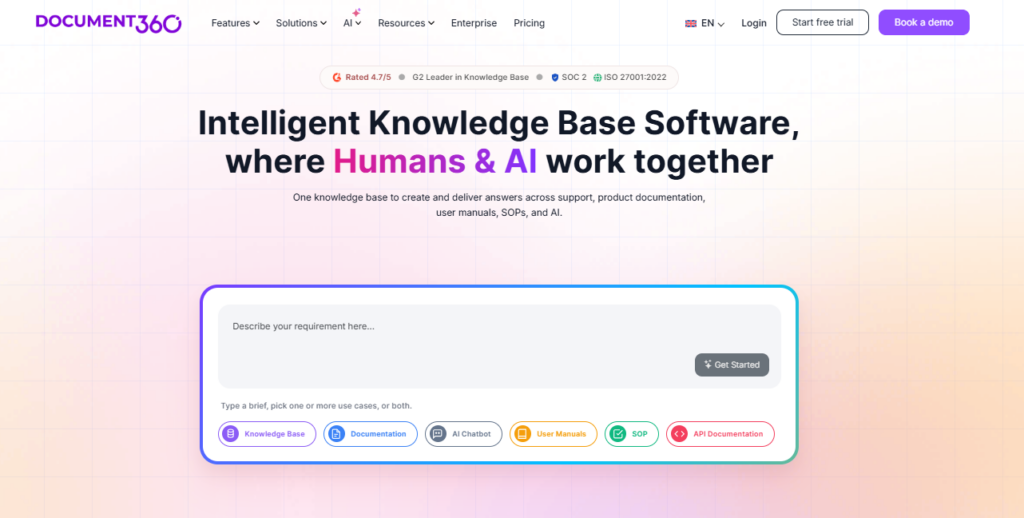
That experience reflects what Document360 is built for. It’s a structured documentation platform for teams who need content tied to specific product versions, with review workflows that keep articles current as the product changes. Product teams, support teams, technical writers, and developers across industries all rely on it for customer-facing help centers, internal SOPs, and API documentation.
Read more: Document360 Alternatives
Key Features
- AI-powered search that returns direct answers
- Custom workflow builder that routes articles through approval stages before they go live
- Article revision history with rollback so teams can revert to any previous version
- Interactive Decision Trees for guiding readers through complex processes step by step
- Multilingual support across 40+ languages with AI-assisted translation
Cons
- G2 reviewers note that analytics are only available at the individual workspace level, making it difficult to get a consolidated view of documentation performance across the platform
- HTML export can be buggy, and fixes tend to take a while to be addressed
- API token limits, daily export caps, and other usage restrictions can create additional costs or friction for teams managing documentation at scale
Pricing
You’ll need to reach out to Document360 directly for pricing
Confluence
G2 rating: 4.1/5
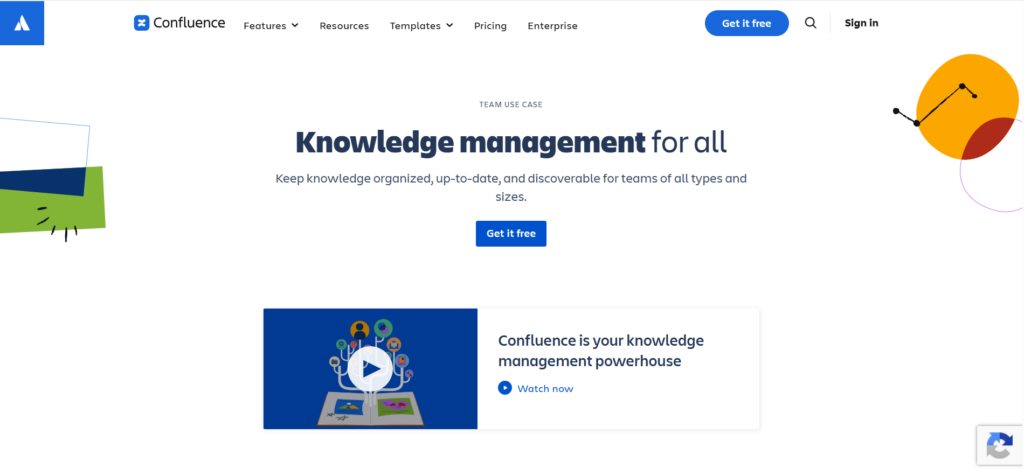
Confluence is Atlassian’s wiki and documentation tool, and the most widely deployed internal wiki in enterprise software. Its tight integration with Jira is the main reason for that adoption: engineering and product teams can link documentation directly to tickets, sprints, and issues.
This makes it the natural home for technical knowledge. It handles nested page hierarchies, templates, and real-time co-editing well. G2 reviewers consistently flag search quality and navigation as weaknesses, particularly as page count grows.
Read more: Confluence Alternatives
Key Features
- Deep native integration with Jira for linking documentation to tickets, sprints, and issues
- Nested page hierarchies and structured spaces for organizing large documentation sets
- Real-time co-editing and inline comments for collaborative documentation
- Free guest access for external collaborators on paid plans
Cons
- Search is frequently cited as a weakness, with older or unrelated pages often ranking higher than what you’re actually looking for
- The page editor can feel slow and clunky when working with large, media-heavy documents or complex nested tables
- Markdown support is inconsistent, which adds friction for developers copying documentation from code repositories
Pricing
If your team is under 10 people, Confluence is free. After that, you’re looking at $5.42/user/month on the Standard plan or $10.44/user/month on Premium, both billed annually. Enterprise pricing is custom.
Microsoft 365 SharePoint
G2 rating: 4.0/5
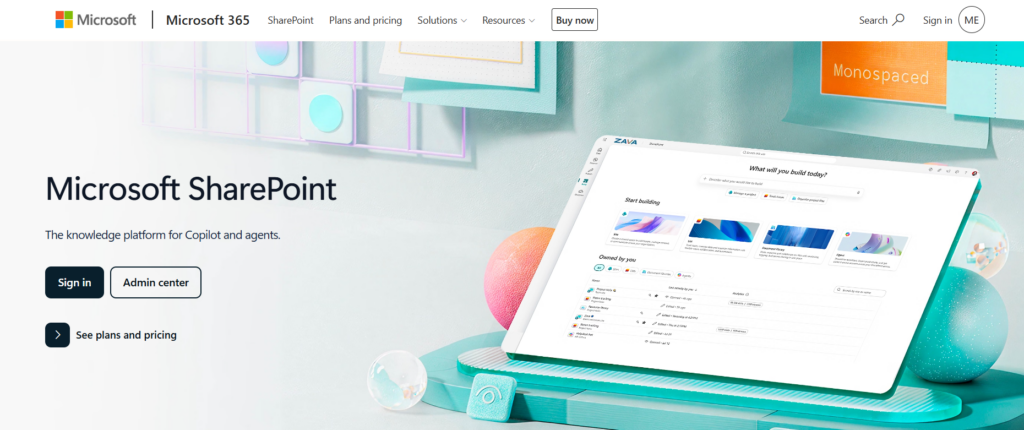
Microsoft 365 is not a purpose-built knowledge management platform, but for organizations already running it, the combination of SharePoint, Microsoft Copilot, and Microsoft Purview creates a functional knowledge management setup without adopting a separate tool.
SharePoint handles document storage, version control, co-authoring, and access governance. Purview adds compliance controls and audit logging. Microsoft 365 Copilot Business, available as an add-on from $18/user/month, lets employees ask questions in conversational language and get answers drawn from across the M365 environment.
That said, Copilot’s answer quality depends entirely on how well the underlying SharePoint content is already organized. Teams with large, unstructured document libraries will likely get better results from a dedicated knowledge management tool that can help structure and govern that content first.
Key Features
- Generative AI answers via Microsoft Copilot, drawing from SharePoint, Teams, email, and M365 content
- Document storage, version control, and co-authoring through SharePoint
- Compliance controls, audit logging, and data governance through Microsoft Purview
- Role-based access controls and information barriers for sensitive content
- HIPAA, GDPR, and financial services compliance support through Purview
Cons
- Setup and customization often require admin or developer support, which makes self-sufficient configuration difficult for most teams
- Poorly structured sites navigation frustrating, with users often digging through deeply nested folders to find documents
- Search can be unreliable, with files sometimes not appearing in results even when they exist in the system
Pricing
Microsoft 365 Business Standard starts at $12.50/user/month and includes SharePoint. Microsoft 365 Copilot is an add-on at $18/user/month.
Notion
G2 rating: 4.6/5
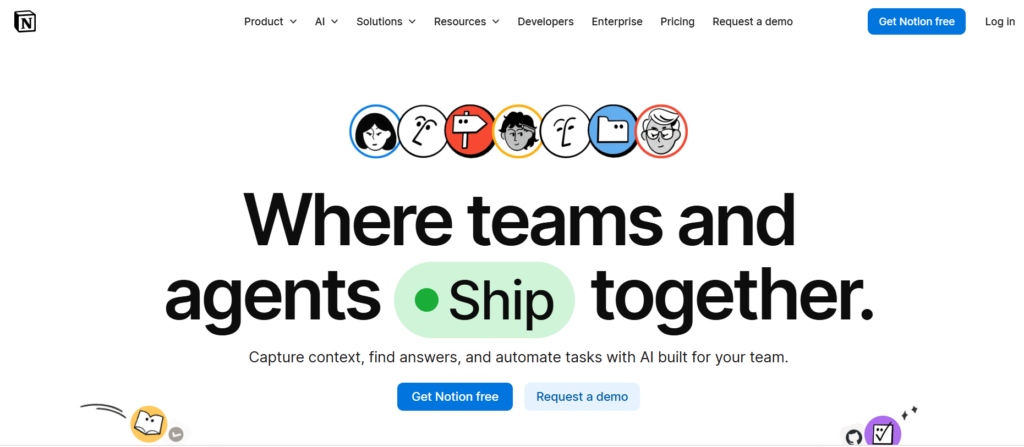
Most tools on this list only offer one core use case, but Notion is built differently. It brings documents, databases, wikis, and project tracking into one workspace. It even includes AI agents that handle recurring work automatically, acting like a built-in project manager for your team.
A product team might use it to replace Confluence for documentation, Trello for task management, and a separate wiki for onboarding guides. An HR team might build an employee handbook, track open roles, and manage onboarding workflows in the same place. What it doesn’t have is compliance-grade audit trails or approval workflows. You may also notice its performance slow down as the workspace grows.
Key Features
- Flexible block-based editor supporting text, databases, tables, kanban boards, and embedded content in one page
- Notion AI Agents for autonomous task execution across databases and documents
- Linked databases that connect knowledge across pages without duplicating content
- Teamspace permissions for controlling access by team or department
- Integrations with Slack, GitHub, Jira, Google Drive, and Zapier
Cons
- Can be overwhelming for new users without a clear starting point or pre-built template
- Performance slows on large databases and complex pages, and the mobile app experience is limited
- There are no compliance-grade audit trails or approval workflows. This makes it unsuitable for regulated environments
Pricing
Notion offers a free plan, with paid plans starting at $10/user/month.
Slite
G2 rating: 4.6/5
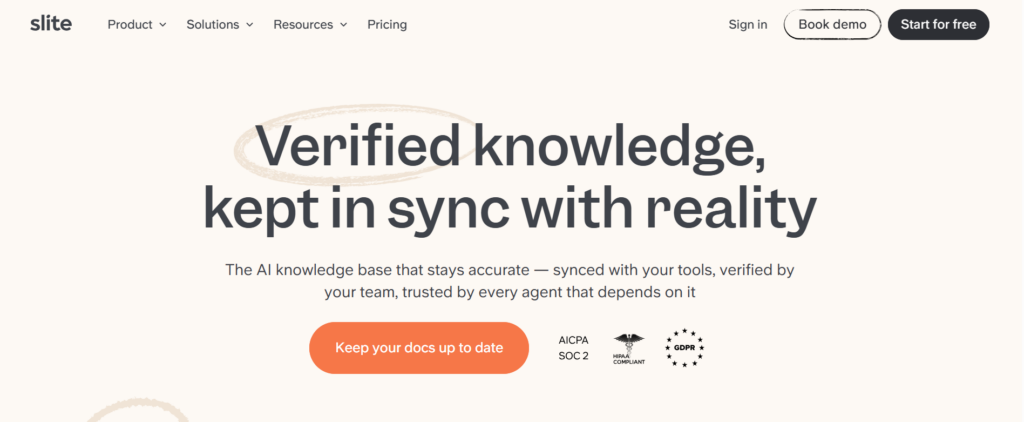
Slite is deliberately simpler than Notion or Confluence. Teams use it to keep documentation clean and current in a platform that’s not bombarded with ten other unnecessary features. The standout feature in 2026 is Slite Agent, which monitors documentation for outdated content, draft updates, and routes them to the right person for review.
A team that documented their onboarding process six months ago doesn’t need to remember to audit it. Slite flags it when the content starts to drift and surfaces a suggested update for someone to approve. One thing worth noting: as workspaces grow and page count increases, finding older content can take more time, which is worth factoring in for larger teams.
Read More: Slite Alternatives
Key Features
- Clean, distraction-free editor focused on writing and structured documentation
- Slite Agent that monitors content for drafts updates and routes for human approval
- Threaded comments and post replies for async discussion without leaving the document
- AI search and answers across all Slite docs
- SAML SSO on Premium plan
Cons
- Finding older content takes longer as the workspace grows, and some advanced search and organization options have a learning curve
- Occasional bugs such as page crashes when pasting data or scrolling issues can cause minor disruptions
Pricing
Slite starts at $10/user/month, billed annually.
Tettra
G2 rating: 4.7/5
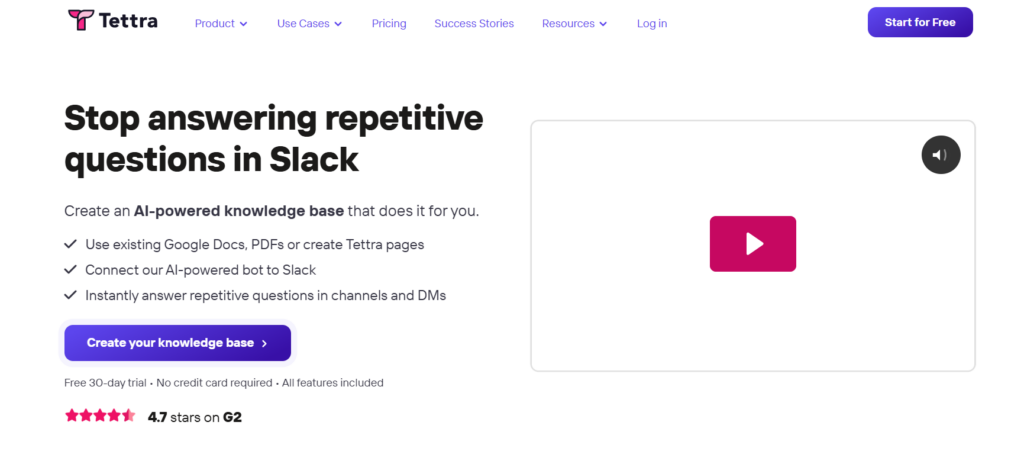
Tettra is built for small teams that already live in Slack. You can ask a question in a channel and the AI assistant finds the answer in the knowledge base and responds with a citation, without anyone leaving Slack or opening another tab. The limitation, as with most lightweight tools, is scope. Tettra is quick to set up and easy to maintain, but it wasn’t built to scale beyond small teams and has no compliance-grade governance.
Key Features
- AI assistant that answers questions directly inside Slack with source citations
- Suggest and verify workflows where team members can flag outdated content for review
- Simple knowledge base editor for creating and organizing articles without technical overhead
- Microsoft Teams integration in addition to Slack
- Role-based permissions for controlling content access
Cons
- Tettra works best when the whole team is actively using it. If adoption is patchy, the knowledge base quickly becomes incomplete and less useful
- Search results aren’t always reliable, and the search experience still needs work, according to G2 reviewers
Pricing
Tettra starts at $8/user/month (billed annually, 10-user minimum), with a 30-day free trial available.
Helpjuice
G2 rating: 4.7/5
Your support team has a list of questions they answer on repeat:
- How do I reset my password?
- Where’s my order?
- What’s your return policy?
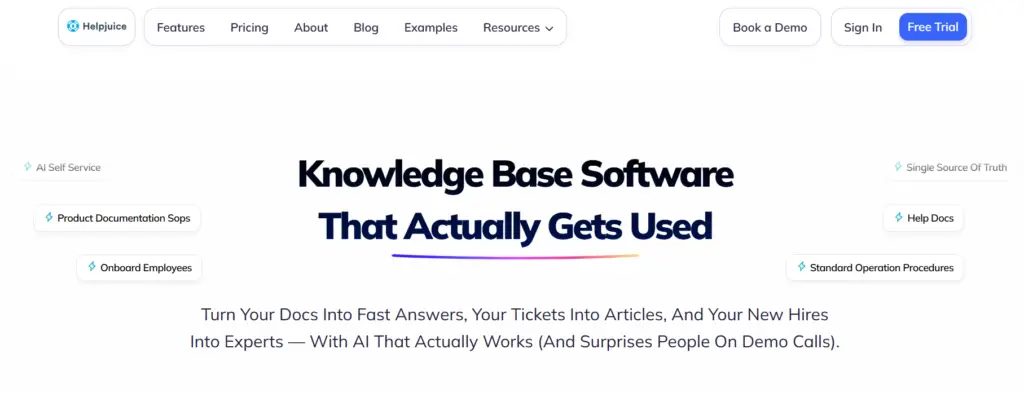
Helpjuice gives customers a place to find those answers themselves, without calling or emailing your team. It also works internally, for employee onboarding, operations documentation, and cross-department knowledge sharing.
G2 reviewers consistently point to the AI search and chatbot as the features that drive ticket deflection, and the branding customization means the knowledge base looks like part of your product.
One thing you should know before you sign up is that the base plan at $249/month doesn’t include any AI features. The AI Suite, which covers AI Search, AI Writer, and the AI Chatbot, only unlocks at the $449/month tier.
Learn more: Helpjuice Alternatives
Key Features
- AI-powered search returning direct answers rather than link lists
- AI chatbot for conversational self-service on the help center
- Deep branding customization with free expert design service included across all plans
- Real-time collaboration for authoring and editing articles
- Analytics covering article views, search queries, and reader engagement
- 300+ integrations including Salesforce, Zendesk, Slack, and Intercom
Cons
- Managing large knowledge bases requires manual effort to keep article formatting and category structure organized
- Live chat support isn’t available inside the editor, which makes resolving complex issues slower when you need a real person
- The AI chatbot occasionally gives inaccurate answers, and there’s currently no way to flag incorrect responses directly in the chat
Pricing
Helpjuice starts at $249/month, but AI features aren’t included until the $449/month plan.
Key Features to Look for in AI Knowledge Management Software
Knowing what to look for before you start evaluating tools will save you time and help you avoid platforms that work in a demo but fall short in practice. Here are the features that matter most:
AI-Powered Search
When an agent is on a live call, they don’t have time to guess the exact keyword that matches a policy document. AI-powered search combines natural language processing and vector search to understand the intent behind a query, so employees find what they need even when the words they use don’t match the document exactly.
During any trial, test the search with real queries your agents use every day. If it struggles with natural language or typos during the trial, it will struggle when your agents need it most.
AI Content Authoring and Summaries
Every department documents processes differently, and when those articles end up in the same knowledge base, agents with varying technical backgrounds may find it difficult to interpret what they’re reading.
AI authoring tools review content as it’s written and suggest improvements to language and structure so every article is easier to read across the organization, regardless of who wrote it.
Summaries work alongside this. Instead of opening a full policy document during a call, agents get a concise answer pulled directly from verified content, with a link back to the source for reference.
Knowledge Analytics and Gap Detection
A knowledge base only stays useful if someone monitors how it’s being used. Analytics show you which searches return no results and where agents are spending most time.
If agents search for the same term repeatedly without clicking anything, that’s a signal the content either doesn’t exist or isn’t findable in its current form, and it needs to be addressed before it affects customer interactions.
Governance and Compliance
When a policy changes but there’s no approval workflow controlling which version goes live, agents end up working from different documents. Customers get conflicting answers, and if a regulator asks what information was available on a specific date, there’s no record to show them.
A proper governance system prevents this. It routes every content change through structured approvals, logs a full version history with timestamps, enforces automated expiry dates so stale content gets flagged before it causes problems, and restricts access by role so each team only sees what’s relevant.
For teams handling sensitive customer data, the system should also scan for PII like names and payment details and redact it automatically before anything gets shared or published.
Document Ingestion and Auto-Structuring
Organizations have years of useful knowledge sitting in PDFs, Word files, and presentations that employees never search because those files aren’t connected to the knowledge management system.
AI-powered document ingestion lets teams upload existing files directly, without any manual rewriting or restructuring required.
The system indexes the content and makes it searchable alongside authored articles, so legacy documents become immediately useful.
Integrations With Existing Workflows
Agents shouldn’t have to leave the tools they’re already working in to find an answer. When a Salesforce user has to open a separate tab to search a knowledge base, they lose context and slow down. The best knowledge management platforms surface relevant content directly inside CRM systems, browser extensions, helpdesk platforms, and collaboration tools.
How to Choose the Right AI Knowledge Management Software
As you compare tools, the most important first step is defining the problem you’re actually trying to solve before shortlisting by category. If you haven’t mapped out your requirements yet, a clear knowledge management strategy will save you significant time and help you avoid evaluating platforms against the wrong criteria.
Here are a few more things to keep in mind when choosing an AI knowledge management software:
Start With Your Primary Use Case
Define your problem first, then shortlist by category.
- Contact Center or Regulated Industry? You need fast in-call search, decision tree guidance, governance workflows, and compliance features. livepro is purpose-built for this environment. A general-purpose wiki won’t solve a contact center knowledge problem regardless of how good its AI features are.
- Scattered Knowledge Across Ops or Marketing? You need collaborative documentation with flexible structure and good search. Notion, Slite, or Confluence are better fits for this kind of team.
- Need Structured Product or Technical Documentation? Document360 is built for this, with content approval workflows and API doc support built in.
- Need a Flexible, Branded Knowledge Base for Customers and Internal Teams? Helpjuice is worth considering.
Evaluate Compliance and Governance Requirements
Compliance is a prerequisite for any team operating in a regulated industry. Ask every vendor whether they offer all of the following, and if they can’t give you a clear answer on each point, move on.
- Automated content expiry dates
- Structured approval workflows before content goes live
- Full version history with rollback
- A complete audit trail with timestamps on every change
- Role-based access controls so the right people see the right content
- PII detection and redaction
For contact centers and regulated industries, livepro’s governance features cover all of the above. livepro’s AI also runs on its own servers, so no customer data passes through external AI providers.
Test AI Accuracy: Hallucination Risk and Source Attribution
Some tools use RAG to pull answers from your approved content. Others generate answers from broader training data, which means plausible-sounding responses that may be completely wrong.
During any trial, ask the vendor the following:
- Does the AI answer only from content in our knowledge base, or does it pull from external training data?
- Does every answer include a source citation linking back to the original article?
- What happens when the answer isn’t in the system? Does it say so, or does it guess?
livepro attributes every answer to a specific source document. Most general-purpose tools on this list don’t offer that level of traceability.
Assess Integration Depth
Test every integration your team would actually use day to day.
- livepro integrates natively with Salesforce, Zendesk, Genesys Cloud, NICE CXone, Microsoft Teams, and Slack, with an open API for custom integrations.
- Guru’s Chrome extension and Slack integration are the features G2 reviewers consistently rate as most useful in day-to-day work.
- Tettra is the simplest option for small teams that want knowledge base answers delivered directly inside Slack without any additional setup.
Calculate Total Cost of Ownership
The per-seat price is rarely the full cost. Before signing anything, factor in:
- Migration from your current system
- Implementation and configuration time
- Staff training
- Ongoing admin overhead
- And any premium features gated to higher tiers like SSO, API access, and advanced analytics.
Quick-Pick Table: Best Tool by Org Type
| If you are | Prioritize | Best fit |
| A contact center in a regulated industry | Compliance workflows, PII redaction, audit trails, decision trees, fast in-call search | livepro |
| An enterprise with multiple departments (HR, Legal, Finance) | AI search, content authoring, cross-department access controls, governance | livepro, Guru |
| A BPO managing knowledge across multiple clients | Multi-tenant support, role-based access, scalability, compliance | livepro |
| A sales or GTM team needing real-time knowledge sync | CRM integration, Slack delivery, knowledge verification, in-workflow answers | Guru |
| A large enterprise with complex content types (video, audio) | Deep-index search, analytics, collective Q&A | Bloomfire |
| A tech-focused team in the Atlassian ecosystem | Native Jira integration, structured pages, team collaboration | Confluence |
| A Microsoft-first enterprise | M365 integration, SharePoint governance, Copilot AI answers | Microsoft 365 SharePoint |
| A SaaS company building a customer help center | Self-service AI search, versioned docs, multilingual support | Document360 or Helpjuice |
| A remote or async team wanting clean documentation | Structured writing, async collaboration, AI maintenance | Slite |
| A small team that lives in Slack | In-Slack AI answers, lightweight setup, low admin overhead | Tettra |
The Future of AI Knowledge Management Software
The tools reviewed in this guide represent where the market stands today. Here’s where it’s heading.
- Agentic AI. The shift is from systems that wait to be searched to systems that fix problems on their own. If there’s a gap in your knowledge base, the AI detects it and generates a draft before routing it to the right person for review. Slite Agent and Notion’s Custom Agents already work this way in limited form.
- AI Voice Agents. Typing a question into a knowledge base is being replaced by asking out loud. Back in 2022, Gartner predicted conversational AI would cut contact center labor costs by $80 billion by 2026, with one in ten agent interactions fully automated. livepro’s Luna is already handling inbound calls outside business hours and drawing answers from the verified knowledge base.
- Proactive Knowledge Delivery. The next step beyond fast search is a system that surfaces information before the agent looks for it. When a customer mentions fraud, the escalation process appears on screen without a search. This capability is already emerging across contact centers, and how well it works depends on the accuracy of the underlying knowledge base.
- Knowledge Graphs and RAG. Current AI search finds relevant articles and stops there. Knowledge graphs map how those articles connect to each other, showing how a policy links to its exceptions and how a past decision affects a current one. GraphRAG research puts its accuracy at 80% compared to 51% for standard AI search because it reasons across connected information rather than just retrieving it.
Bottom Line: livepro is the Best AI Knowledge Management Software in 2026
The tool that fits your contact center won’t fit a remote startup team. And the tool that’s perfect for a SaaS help center will frustrate a compliance officer in financial services.
If your agents are wasting time giving inconsistent answers during live calls, or if your compliance team worries every time a document goes out without proper review, you need a platform built for that environment.
The tools in this guide cover every major use case. Contact centers and enterprises in regulated industries will find the strongest fit in livepro.
Book a demo to see how livepro helps contact center and enterprise teams find answers faster and reduce handling time.
FAQs About AI Knowledge Management Software
What is the best AI knowledge management software for contact centers?
livepro is the strongest option for contact centers, particularly in regulated industries. It offers fast in-call search and RAG-powered AI answers drawn only from verified content. It also offers decision tree guidance for complex processes and built-in governance workflows. See how it performs in contact center settings.
How does AI knowledge management software handle compliance in regulated industries?
Compliance-grade platforms include automated content expiry, structured approval workflows, full version history, role-based access controls, and a complete audit trail. livepro adds PII redaction and runs all AI on its own servers, so no customer data is sent to external AI providers.
Is AI knowledge management software secure enough for healthcare and financial services?
Most general-purpose tools offer standard cloud security and SOC 2 certification. Healthcare organizations subject to HIPAA need PII detection and redaction, audit trails of every access and change, and a clear data processing agreement covering protected health information.
livepro is SOC 2 certified and HIPAA compliant for US customers. If your organization lives in Microsoft 365, SharePoint with Microsoft Purview provides comparable compliance controls within that ecosystem.