

A compliance audit flags that 40 agents have been quoting a fee that changed in March. The article was never updated. The manager responsible left six months ago, and ownership was never reassigned. No one can tell you when the error started or how many customers were affected.
That’s what a knowledge base without governance looks like.
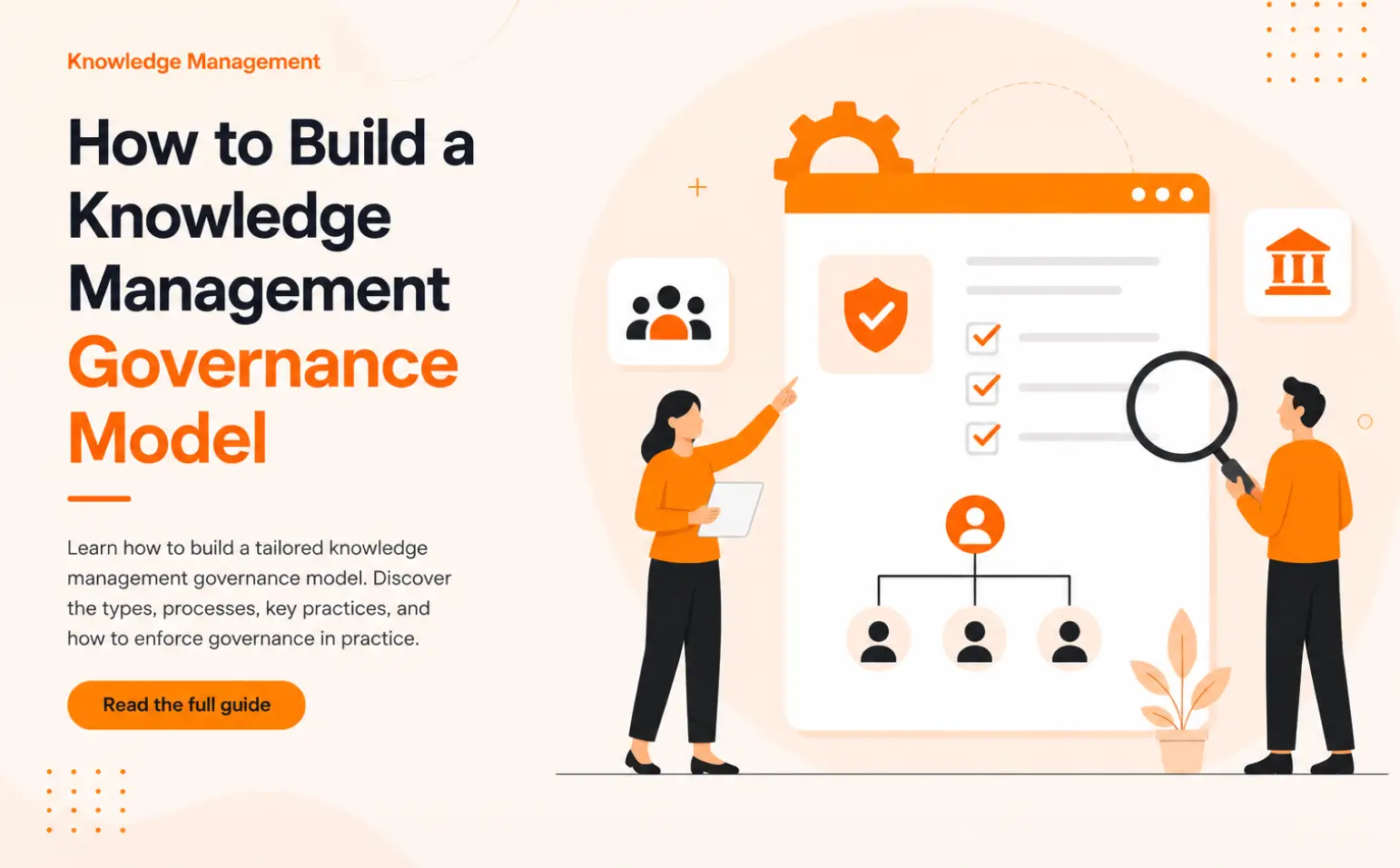
A knowledge management governance model gives your organization the structure to define who owns content, how updates get approved, and what happens when something changes.
In this article, we’ll discuss the knowledge management governance model, its types, and how to choose the right one for your organization. You’ll also learn how to design your own governance model and the tool you can use to enforce it in practice.
What is a Knowledge Management Governance Model?
A knowledge management (KM) governance model defines how authority, ownership, and content processes are distributed across your organization. It helps you define who has the decision-making power and how it flows across teams, departments, or business units.
Three Main Types of KM Governance Models
There are mainly three types of knowledge management governance models. Each one distributes authority differently, and the right choice depends on how your organization is structured.
Centralized Model
In the centralized KM model, all knowledge authority belongs to a dedicated team. They control what gets created, reviewed, and published across the entire organization.
This model works best for regulated industries where consistency and compliance aren’t optional. Financial services firms, insurance companies, and healthcare organizations run centralized governance because one wrong answer carries real consequences.
But since every update goes through a single team, the publishing cycles are slower. A team has to review each piece of content closely before they approve it for publication.
Distributed Model
A distributed model makes sure each department or business unit manages its own knowledge independently. There’s no central authority. Teams set their own standards, workflows, and review cycles. This gives teams flexibility and ownership.
But without a shared standard, your knowledge can become inconsistent across departments. For example, the same policy question can get three different answers depending on who you ask.
Distributed model works for large enterprises with highly distinct business units where shared standards aren’t practical. But it’s the hardest model to scale.
Federated Model
The federated model combines elements of both approaches. A central body sets the overarching standards: taxonomy, review cadence, and approval requirements. Individual teams then execute within those boundaries.
For example, a BPO (business process outsourcing) can maintain separate knowledge bases for each client while applying the same approval workflow, review cycle, and access controls across all of them. Or a large council can let each department manage its own content while still publishing through a shared governance structure.
This is the most common model in enterprise contact centers as it balances consistency with flexibility.
How to Choose the Right KM Governance Model
| Centralized | Distributed | Federated | |
| Best for | Regulated industries (finance, insurance, healthcare) | Large enterprises with highly distinct business units | BPOs, multi-department orgs, large councils |
| Decision-making | One central team | Each department independently | Central standards, local execution |
| Compliance fit | Strong | Weak | Strong |
| Speed of updates | Slower | Fast | Medium |
| Use this model when | Accuracy and compliance are priorities | Different teams have different knowledge needs | Need both consistency and departmental autonomy |
| Risk if misapplied | Bottlenecks slow down publishing | Conflicting answers across departments | Weak central standards undermine the whole model |
How to Set Up a Knowledge Management Governance Model
A knowledge management governance model has four pillars, and each one needs to be defined before your model can work in practice.
Roles and Responsibilities
Every governance framework starts with people. If no one owns a piece of knowledge, no one updates it. If no one updates it, it goes stale. And stale knowledge is where compliance gaps start.
Four roles make governance work:
- Content creator: Writes and structures knowledge articles based on input from subject matter experts.
- SME reviewer: Validates accuracy. They confirm the content reflects current processes, policies, and regulations.
- Approver/owner: Signs off before anything goes live. They’re accountable for what gets published.
- Knowledge manager: Oversees the system. They monitor review cycles, track gaps, and make sure the framework is followed across teams.
Defining these roles is the easy part. The hard part is making sure people actually follow through, especially your SME reviewers.
In most contact centers, SMEs are team leads or senior agents already handling escalations, coaching, and their own call queues. Knowledge reviews become the first task they drop when volume spikes, and that single bottleneck can stall your entire publishing pipeline for weeks.
The fix is to treat reviews as a core responsibility, not a side task. Build review assignments into weekly team meetings or sprint cycles. Set deadlines with the same weight as any operational KPI. If reviews depend on people finding spare time between calls, they won’t happen consistently enough to sustain governance.
Processes
Your governance framework needs a defined content lifecycle that every piece of knowledge moves through: Create, Review, Approve, Publish, and Retire.
You also need to define what triggers a review. There are three types:
- Change-led reviews: A product update, regulation change, or policy shift triggers an immediate review of affected content. These are reactive but critical because they catch risks before agents act on outdated information.
- Audit-led reviews: Content is reviewed on a set schedule, regardless of whether anything has changed. Quarterly reviews for compliance-critical articles, annual reviews for stable content. These are proactive and keep the knowledge base from quietly decaying.
- Emergency updates: Not every change follows a scheduled cycle. A regulator issues a directive on a Friday afternoon. A product recall goes public. A pricing error needs correction before the next shift starts. Your governance model needs a fast-track path for these situations that compresses the review timeline without removing accountability.
Define who has authority to approve emergency updates, how the change gets documented after the fact, and how the affected article re-enters the standard review cycle once the urgency passes. Without this path, teams will either skip governance entirely during a crisis or wait for the standard process while agents give wrong answers.
Policies
Policies are what keep your governance processes consistent across teams. Without clear policies, two departments will follow the same lifecycle in completely different ways, and your knowledge base will reflect that inconsistency.
Your governance policies should cover:
Review cadence by content risk tier: Not all content carries the same risk, so it shouldn’t all follow the same review schedule. Tier your content based on the consequences of it being wrong.
- Tier 1 (compliance-critical): Regulatory policies, legal disclosures, pricing, and fee structures. Review quarterly, because errors here create audit findings, fines, or customer complaints.
- Tier 2 (operational): Standard processes, internal SOPs, and escalation procedures. Review every six months, because these change less often but still affect how agents handle calls.
- Tier 3 (general reference): FAQs, how-to guides, and general product information. Review annually, unless a specific change triggers an earlier review.
This tiered approach keeps your review workload manageable. If you assign the same 90-day cycle to every article, your team burns out reviewing low-risk content while high-risk articles get the same priority as a general FAQ.
Access controls: Define permissions by role, not by individual. Set who can view, edit, approve, and publish, so the system scales as your team changes without requiring manual cleanup.
Naming conventions: Consistent titles and tags make content easier to find and easier to audit. When every team names articles differently, search accuracy drops and duplicate content builds up.
Content expiry: Assign expiry dates that align with each article’s risk tier. When an article reaches its expiry date without a completed review, it should be flagged or pulled from circulation automatically.
For regulated industries, governance policies carry legal weight. Financial services teams need every article that touches pricing, fees, or disclosures to carry a complete audit trail that proves what was published, who approved it, and when.
Healthcare organizations operating under HIPAA need access controls that restrict clinical guidelines and patient-facing procedures to authorized roles, with documented proof of who accessed what. Government agencies face freedom of information requests that require version histories showing exactly how a public-facing policy evolved over time.
In these environments, your governance policies aren’t operational preferences. They’re the documentation you produce when an auditor, regulator, or legal team asks you to prove that agents were working from approved, current information on a specific date.
Metrics and KPIs
Governance only works if you can measure whether it’s producing results. KPIs give you that visibility, but they’re only useful when you have benchmarks to compare against. Here are the metrics that matter most for contact center governance, with reference points from organizations that have implemented structured KM governance.
- Utilization rate: Tracks whether agents are actively using the knowledge base during their daily work. A low utilization rate usually means agents don’t trust the system or can’t find what they need. TSA Group achieved a 95%+ utilization rate across all channels after centralizing and governing their knowledge base with livepro, which shows what structured governance and reliable search can produce.
- Compliance rate: Measures the percentage of published content that has completed the full approval workflow before going live. Atlanticus closed every compliance gap after implementing governance workflows in livepro, reaching 100% compliance across targeted call centers.
- Content freshness score: Shows the percentage of articles reviewed on schedule versus those that are overdue. If this number is dropping, your review cadences are too aggressive for your team’s capacity, or your SME reviewers are overloaded.
- AHT impact: Measures whether governed knowledge is actually reducing average handle time. ME Bank cut AHT by 40% after replacing an ungoverned SharePoint wiki with livepro’s structured knowledge base. That reduction came from agents finding accurate answers faster, which is a direct result of content being reviewed, approved, and organized through a governance model.
- Knowledge gap rate: Tracks the percentage of agent searches that return no results. A high gap rate tells you that agents need answers your knowledge base doesn’t have yet. This metric is a leading indicator because it surfaces content problems before they show up in customer complaints or QA scores.
Why Governance Matters More When AI Enters the Picture
Most contact centers are already using or evaluating AI features like generative summaries, AI-assisted search, and voice agents that handle inbound calls. These tools pull answers directly from your knowledge base, which means the quality of every AI-generated response depends entirely on the quality of what’s underneath it.
When governance is strong, AI becomes a multiplier. It serves verified, approved answers faster than any agent could find them manually. But when governance is weak, AI does the opposite. It scales wrong answers across hundreds of calls before anyone catches the error, because the system has no way to distinguish a stale article from a current one.
A 2026 report on AI in knowledge management found that organizations with fragmented or outdated knowledge saw AI amplify problems rather than solve them. Forrester research reinforced this, noting that poorly maintained repositories produce incorrect AI outputs that propagate across customer interactions.
This is why your governance model needs to account for AI from the start. Every article that feeds an AI summary, a chatbot response, or a voice agent answer should carry the same ownership, review cycle, and approval trail as any agent-facing content.
Case Study: How Atlanticus Overcame Compliance Issues With KM Governance Model
Atlanticus, a US-based financial services company, was dealing with governance failures before implementing livepro.
The Problem
Their team was dealing with several compounding problems:
- Low documentation usage: Agents used official documentation less than 5% of the time, relying on unofficial tools and memory to answer customer questions.
- Slow, inaccessible system: Policies were hard to find, and the system was too slow to be useful during live calls.
- Broken update process: Critical updates went out as manual PDFs and emails, which were impossible to track.
- No content ownership: No one was accountable for keeping information accurate or current.
- No review cycles: Compliance gaps built up silently with no process to catch or close them.
- No audit trail: Inconsistent answers across agents created regulatory risk with nothing to fall back on during audits.
The Solution
Atlanticus implemented livepro to centralize their knowledge base and put a proper governance structure around it. They enforced content ownership, approval workflows, and review cycles. Every piece of content had to pass through a structured author → review → approve process before agents could access it.
Critical updates were replaced with instant, system-wide announcements, so the right information reached agents the moment it changed. The agents could also use the “Rocket” question-and-answer tool for accurate, situation-specific responses without having to interpret long policy documents.
The Results
After applying livepro, the Atlanticus team reported the following results:
- 14% reduction in AHT from 266 seconds to 230 seconds
- 100% agent adoption across targeted call centers
- 100% compliance, with every governance gap closed
- 2,000+ pieces of agent feedback submitted, showing high engagement and trust in the system.
“livepro’s detailed insights are incredible. Now, I can see exactly what agents are accessing, when, and for how long, which has been a game changer for our operations,” says Michael Gajeski, Documentation Manager at Atlanticus.
How livepro Helps You Enforce Knowledge Management Governance Model
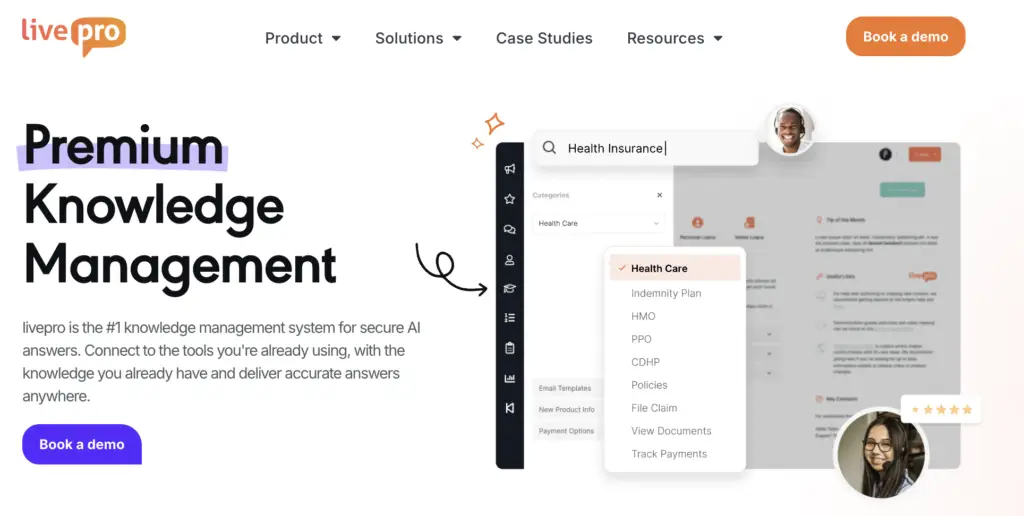
livepro is a knowledge management tool built for contact centers and enterprise teams. The platform helps you structure and centralize operational knowledge into a single source of truth, so teams can instantly get the right information.
But beyond storing knowledge, livepro enforces how it’s managed. The built-in governance tools let you assign content ownership, define approval workflows, set review cycles, and control who can view, edit, and publish.
Here’s how livepro enforces each pillar of your governance model in practice:
Knowledge Article Workflows for Standardized Publishing
When approvals happen over email, Slack messages, or informal sign-offs, there’s no consistency, no accountability, and no way to prove compliance during an audit.
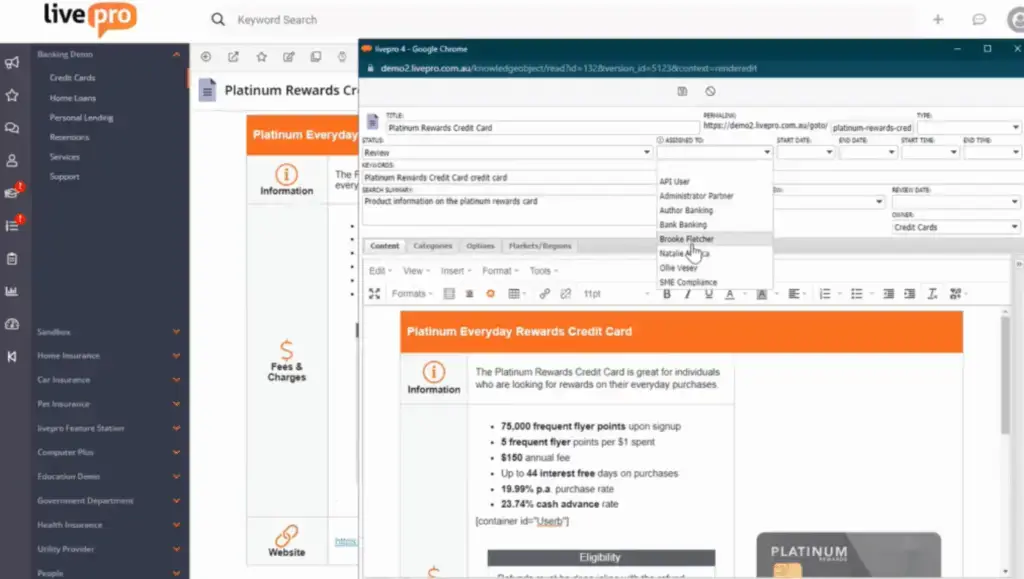
livepro’s Knowledge Article Workflow package helps you move every piece of content through a structured sequence before it goes live. Each stage has a defined owner, a deadline, and a clear handoff. Nothing moves forward until the right person approves it.
Here’s how it works:
- The content creator drafts the article
- SME validates accuracy
- The compliance officer confirms regulatory alignment
- Then the article reaches agents.
If any stage is missed, the content doesn’t progress. This way, you’re able to maintain a strict governance model without overlooking every single piece of content entering your system.
Every stage is fully visible to everyone involved. Reviewers can see exactly where an article sits in the pipeline, who’s holding it up, and how long it’s been waiting. That transparency alone eliminates most of the bottlenecks that slow knowledge updates down in ungoverned systems.
Role-Based Permissions to Maintain Control
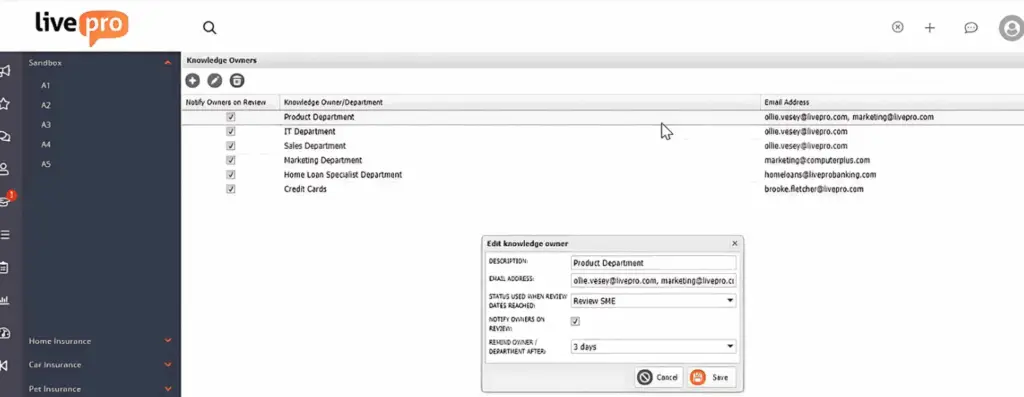
livepro supports role-based permissions that let you define what each person can do within the knowledge base. Viewers can read content. Editors can draft and suggest changes. Reviewers can approve or reject. Publishers can push content live. No one acts outside their scope, and no one can skip a step in the process.
This gives knowledge managers full visibility across the system without necessarily having publishing rights over every department’s content.
Permissions also sync with the platforms your teams already use, including CRM and workforce management tools, so access controls stay consistent. You can also update someone’s permission based on their new role. There’s no manual cleanup, and no window where someone has access they shouldn’t.
Version Control With Clean Audit Trails
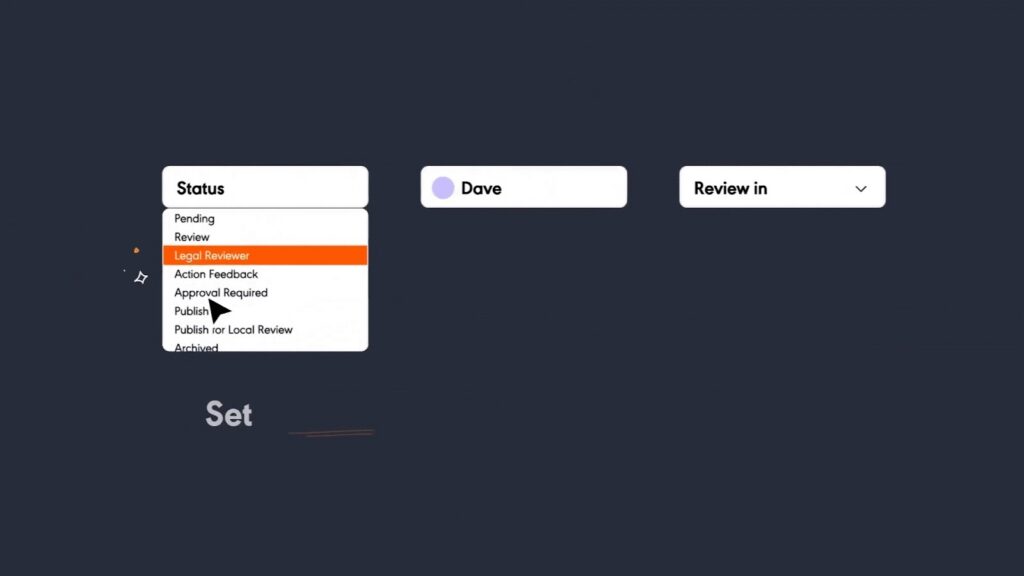
Without a system of record, you don’t have governance over your knowledge base.
livepro tracks every edit, every approval, and every publish across the entire knowledge base. Each article carries a full version history that shows exactly how it evolved over time, who touched it at each stage, and what was changed.
For example, if a compliance officer needs to verify what information an agent had access to on a specific date, the answer is in the audit trail.
livepro also removes the risk of losing content with version control. If an update introduces an error or a policy reverts to a previous version, knowledge managers can compare versions side by side and restore the previous one in a single click. You don’t have to rewrite or guess what the original said.
Automated Review Reminders and Content Expiry
livepro automates the entire review process so content stays current without manual follow-up. Here’s how it works:
- Scheduled review reminders: Content owners receive automated notifications when an article is approaching its review date, depending on the content type and risk level.
- Overdue content tracking: Articles that miss their review date are flagged in the dashboard, giving knowledge managers full visibility over what’s fallen behind and who’s responsible for it.
- Content expiry: Articles that aren’t reviewed and approved by their expiry date are automatically pulled from circulation.
- Recurring review cycles: Once a review is completed, the next cycle starts automatically. Compliance-critical content stays verified without anyone having to restart the process.
For example, a compliance-critical refund policy due for review in 90 days triggers an automatic reminder to the content owner at day 75. If it isn’t reviewed and approved by day 90, it will be pulled from the knowledge base until it is.
Knowledge Analytics to Track Governance Model Success
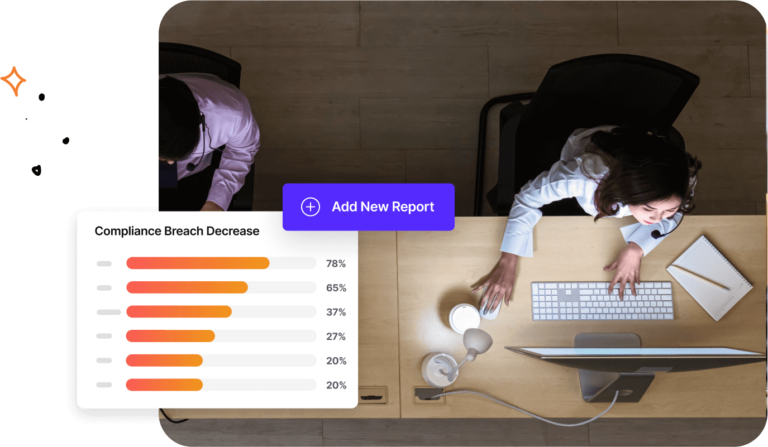
Defining KPIs is one step. Tracking them without building manual reports is another. livepro gives knowledge managers a dashboard that surfaces governance health across the entire knowledge base in real time, so you can act on problems instead of compiling spreadsheets about them.
The dashboard shows which articles agents are accessing, how often, and for how long, broken down by team and department. If a recently updated compliance article shows low engagement, you can see it immediately and investigate whether agents aren’t finding it, don’t trust it, or haven’t been notified about the change.
Search trend data reveals what agents are looking for most, which helps you prioritize content creation and spot training gaps. When a search returns no results, livepro flags it as a knowledge gap so content managers can act on it before it starts affecting call quality.
Overdue reviews are visible at a glance across the entire knowledge base. Instead of tracking review dates in a spreadsheet or relying on individual owners to self-report, knowledge managers can see every article that has missed its review cycle and who is responsible for it.
Your Governance Model Only Works If It’s Enforced
The right knowledge management governance model should include the defined roles, processes, policies, and metrics, so you can maintain a strong knowledge base.
But governance only works if it’s enforced consistently, and that’s where most organizations struggle. Manual follow-up breaks down over time, review cycles get missed when workloads spike, and access controls drift as teams change. The framework ends up existing on paper but not in practice.
livepro solves this with a comprehensive knowledge management system built for contact centers and enterprises. It offers built-in governance tools, including workflows, ownership, and role-based permissions, version control, review reminders, and analytics.
Book a demo to see how livepro helps you enforce your governance model so knowledge stays accurate, compliant, and audit-ready at scale.